
Apollonius’ Argonautica: 7 Reasons To Read It Right Now
Have you ever read Apollonius’ Argonautica? If not, now is the time! I’ll explain exactly why you should read this amazing epic, and I’ll share a list of my favorite English translations.
When someone mentions Ancient Greek epic, most people think of The Iliad or The Odyssey. But today I’m not here to discuss Homer. Achilles and Odysseus get enough attention.
Instead, I want to spotlight the unfairly neglected tale of a daring quest to the ends of the world. I want to introduce you to Apollonius of Rhodes’ Argonautica.
Have you ever heard of Jason and the Argonauts? Probably at least in passing, thanks to the 1963 adventure movie of the same name. Well, that (very cheesy) film is based, rather loosely, on Apollonius’ account.
Believe me, the book is a LOT better. (I know, I’m a Classics professor, so I have to say that. But it’s also true!)
Keep reading to find out why Apollonius’ Argonautica deserves a spot on your reading list – and which are the best English translations!
This post may contain affiliate links and I may receive a commission, at no extra cost to you, if you make a purchase through a link. See my disclosures for more details.
If you’re in a rush, here’s the quick info: I recommend Aaron Poochigian’s English translation of the Argonautica. You can purchase it on Bookshop and Amazon.

This verse translation is beautiful and easy to read! Poochigian has kept old-fashioned lingo at a minimum, so you can actually understand what is happening.
Plus, the back of the book includes handy notes that provide historical and mythological context. This is my go-to translation when I teach classical mythology and when I read for my own pleasure!
⛵ Grab my favorite translation! ⛵Now let’s discuss what the Argonautica is and why you should read it!
Apollonius’ Argonautica: Setting the Scene
Apollonius of Rhodes, sometimes called Apollonius Rhodius, lived in the 3rd century B.C.E. in Alexandria, Egypt. He was probably born in Alexandria, so his association with the island of Rhodes is a bit of a mystery. What we do know is that he was an excellent scholar and poet.
In the 3rd century Egypt was under the control of the Ptolemies, a Greek dynasty, and consequently a considerable population of Greek elites lived there. Alexander the Great had founded Alexandria back in 331 B.C.E., and the city soon became the cultural center of the Hellenistic world.
The heart of scholarship and poetry was the Great Library of Alexandria, where Apollonius himself served as the head librarian for several decades.
Scholars spent a lot of time compiling and analyzing ancient texts, such as The Iliad and The Odyssey. In fact, it is thanks to their hard work that we have access to these texts today. And then some scholars, like Apollonius, composed original poetic work.
Most of Apollonius’ works have vanished into the mists of time, but his epic Argonautica survives complete.
7 Reasons To Read Apollonius’ Argonautica
1: Apollonius’ Argonautica is the oldest full account of the Argonauts’ quest.
Jason, the Argonauts, and Medea featured in myth long before Apollonius’ time. In fact, the first mention of the voyage of the Argo is in The Odyssey (often dated to the 8th century B.C.E.). And the myth is likely much older.
In the centuries after The Odyssey, lyric poets included the Argonauts in their verses. And this famous play by Euripides (5th century B.C.E.) discussed what happened after Jason and Medea made it back to Greece. But Apollonius is the first (that we know of) to write a full-fledged epic about the Argonauts’ expedition.
So if you are familiar with the quest for the Golden Fleece, read Apollonius to find out where the story came from. And if you don’t know anything about Jason and Medea, keep reading to hear why you should change that!
2: The voyage of the Argonauts is the ultimate hero quest.
Pelias, king of Iolcus in Greece, feels threatened by his nephew Jason. His solution is to send Jason on a dangerous quest to claim the Golden Fleece. Jason must travel from Greece to Colchis (modern Georgia) at the very edge of the ancient world.
The journey is long, the Colchians are hostile, and chances of survival are not high. But Jason rallies a group of Greek heroes and sets sail in the Argo, a ship fashioned with the aid of the goddess Athena.
Jason and his companions are never actually called “Argonauts” in Apollonius. But later tradition dubbed them by this name, which literally means “Argo-sailor” in Greek.
Jason may leave something to be desired as a hero (more about that below) – but the Argonautic quest is still awesome.
3: The Argonautica takes you all over the ancient world.
Jason and the Argonauts travel all over on their journey to and from Colchis, and so we get to see a lot of different places through their eyes. From Greece to the Black Sea coast, from Sicily to north Africa, adventures abound.
As I reread the Argonautica, I felt the urge to get on the road and travel. The Argonauts pass right through the Bosporus, and I remembered the lovely days I spent in Istanbul in summer 2019. Sure, Jason runs into some fantastical friends and foes, but that’s part of the charm.
And speaking of fantastical friends . . . let’s talk about Medea.
4: Medea!
Yes, Medea is in and of herself a reason to read the Argonautica. She is hands down one of my favorite figures in classical literature, despite her dark end as the murderer of her own children.
Most people know about Medea from Euripides’ play Medea, where she goes on a killing spree to get her revenge on Jason. But Apollonius shows us a younger and more naïve Medea, the Medea who is princess of Colchis and yet is willing to betray her family for love.
Medea is probably the most powerful woman in Greek mythology. When Jason has no way to complete his quest, it is Medea who advises him how to acquire the Golden Fleece and saves him numerous times with her spells and witchcraft.
In fact, some scholars argue that Medea, not Jason, is the true hero of the Argonautica. Jason is a bit weak in general, and he certainly would not have succeeded without Medea.
Now, don’t misunderstand – Medea is not some sort of proto-feminist. Despite her great power and keen intelligence, she is very much entangled in the patriarchal beliefs of her age. Two men (her father and Jason) dominate her life, and ultimately her excessive emotion leads to her downfall.
But I still think it is amazing to see the sheer depth of her power and strength of her influence. Which is why the 1963 movie infuriates me with its pathetic, damsel-in-distress version of Medea. It’s a bit odd that an ancient Greek scholar managed to write a more liberated woman than 20th-century filmmakers!
5: The Argonautica is atmospheric and full of possibilities.
Do you know the kind of book that sweeps you away and places you in a whole new reality? That’s what the Argonautica did for me. Myths come alive in a younger and more mysterious world where anything is possible.
It’s a world where herbs can make a man’s skin impenetrable and serpents guard sacred trees. It’s a world where you can see the god Apollo at sunset with his long hair blowing in the breeze. And it’s a world where a young man can win a goddess’s support by carrying her across a flooded river.
And the best part is that all of these things seem perfectly natural and believable. Apollonius presents them in a matter-of-fact tone that leaves no room for doubt.
6: The Argonautica is our one surviving Hellenistic epic.
The Argonautica is the only epic that has come down to us from the Hellenistic age (roughly 323 to 31 B.C.E.). This context was vastly different from the time that produced The Iliad and The Odyssey.
The Homeric epics were the product of an oral tradition that stretched back hundreds of years. There was no one author responsible for their composition. Instead, many poets contributed over the centuries until eventually someone wrote the epics down.
Apollonius of Rhodes, on the other hand, wrote the Argonautica himself. It was he who painstakingly composed every line of hexameter and made decisions about the plot and characters. The Argonautica does, however, constantly look back to its famous predecessors. Just as, a few centuries later, the Roman poet Vergil would look to Apollonius as he wrote his Aeneid.
7. The Argonautica is shorter than most other epics.
This sounds like a joke reason, but it’s not. Especially when you are just getting started reading classical literature, it can be daunting to pick up a tome of 600+ pages.
My favorite translation of the Argonautica is barely 200 pages long. The plot is unified around a single point: retrieve the Golden Fleece. Other adventures branch out from this, but the overall story arc is clear.
This all means that Apollonius’ Argonautica would be a good candidate for my beginner’s list of classical literature.
Best Translations of the Argonautica
I taught a course on ancient epic at Harvard a few years ago, and last semester I taught mythology at Kenyon College. Both courses involved reading selections from the Argonautica, so I needed to pick the best translation possible.
At this point I have explored a few different translations, and wow – I found two amazing English ones!
You can easily find translations of the Argonautica online, but they tend to be old-fashioned and boring. If you want to enjoy your reading experience, then I recommend one of the following two translations.
NOTE: The various editions often have different English names, but don’t worry – they all refer to the same epic.
Jason and the Argonauts, trans. Aaron Poochigian
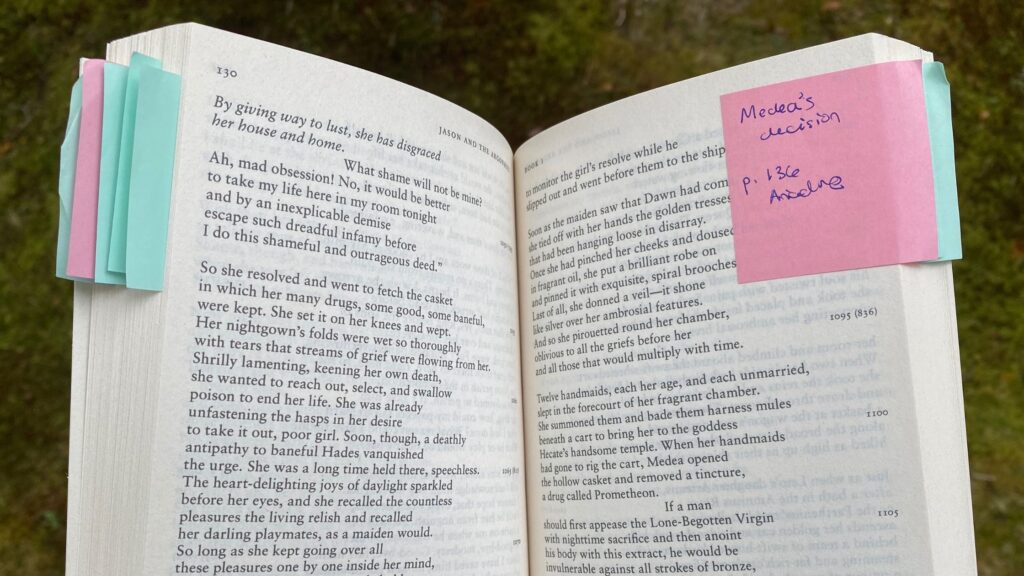
This new Penguin Classics edition was published in 2014. It’s a fun, easy-to-read verse translation in iambic pentameter. There are also a few pages of helpful notes at the back of the book to clarify obscure names and events.
Translator Aaron Poochigian’s stated goal is to convince readers that the Argonautica is a great epic. He certainly convinced me! I thoroughly enjoyed rereading the saga of the Argonauts in his words.
PRO TIP: Make sure you get the 2014 Penguin Classics edition. There is also an outdated one from the 1950s.
👉 Find Poochigian’s translation on Bookshop or Amazon!
Argonautika: The Story of Jason and the Argonauts, trans. Peter Green
I love Peter Green’s translations of ancient literature, and this one is no exception. It’s a pleasure to read his verse rendition of Apollonius. The English is designed to mimic the rhythm of Greek hexameter.
My favorite part is Green’s use of colloquial phrases in conversations. The vivid language helps to bring the Greek to life and you can imagine you are right there with the characters.
Note, though, that Green has also included a detailed commentary at the back of his book, which makes it almost 500 pages long (and also a bit pricier than the Penguin Classics translation).
If you are extremely interested in the historical and literary context of Apollonius’ Argonautica, then you will appreciate this supplementary material. If not, you can always just stick to the text itself.
👉 Purchase Green’s translation on Bookshop or Amazon!
Other Translations
There are many other translations of the Argonautica, as even a quick Google search will indicate. But Poochigian’s and Green’s are my favorite, because they are accessible, entertaining verse translations.
Since Apollonius of Rhodes wrote the Argonautica in dactylic hexameter, I prefer to read English poetry, as well. As Poochigian notes in his introduction, prose versions capture the meaning but leave out the magic.
But if you want a prose translation, I suggest Richard Hunter’s Jason and the Golden Fleece (Oxford World’s Classics, 2009).
Another option is the Loeb Classical Library’s bilingual edition. As is typical with Loebs, the Greek text is on the left and the English prose translation is on the right. If you want to read Apollonius in the original Greek and then check your understanding, this is an excellent choice.
FAQs about the Argonautica
Who wrote the Argonautica?
There are two possible answers to this question. Apollonius of Rhodes wrote the Greek Argonautica (in Ancient Greek), while Valerius Flaccus wrote the Roman Argonautica (in Latin).
When was the Argonautica written?
The answer to this question depends on which Argonautica we are talking about. Apollonius’ Greek Argonautica was written in the 3rd century B.C.E., while Valerius Flaccus’ Roman Argonautica was written in the late 1st century C.E.
What does Argonautica mean?
The Ancient Greek word Ἀργοναυτικά (Argonautika) means “things related to the Argonauts”. An Argonautēs (Ἀργοναύτης) is a “sailor on the Argo”, and Argo is the name of the ship that Jason and his friends sailed in quest of the Golden Fleece.
Modern translations of the Argonautica sometimes use an English name like “Jason and the Argonauts” or “Voyage of the Argo”. Both of these titles work as loose translations of Argonautica.
Go Read Apollonius’ Argonautica!
Now you know the very best translations of Apollonius’ Argonautica, so choose one and go read! You won’t regret accompanying the Argonauts and Medea through their adventures.
When I teach the Argonautica in my mythology classes, we spend a lot of time discussing the following question: What is an epic hero?
Jason isn’t as strong as Heracles or Achilles or as cunning as Odysseus, and he wouldn’t get far without Medea. So why is he a hero? Is he a hero?
There are many different answers to this question, and this is what makes the Argonautica compelling and ever relevant. It questions the very meaning of the epic journey and explores how power, teamwork, and love interact.
👉 Read my favorite translation now!
And if you’re a fan of classical mythology, you might like the following posts:
Valerius’ Argonautica: A Roman Twist on Jason and Medea
Homeric Hymns: Explore Iconic Greek Myths

