
Homeric Hymns: Why You Should Read Them Now
Do you love Greek mythology? Or does it at least intrigue you? Then you should definitely check out the Homeric Hymns.
In this post, I’ll tell you all about the hymns and why you should read them now. We will focus on the four longest and most entertaining Homeric Hymns. They honor the following deities:
- Demeter, goddess of harvest and agriculture
- Apollo, god of reason, prophecy, medicine, music, and poetry (among other things)
- Hermes, god of messengers, thieves, travelers, and merchants
- Aphrodite, goddess of love

This post may contain affiliate links and I may receive a commission, at no extra cost to you, if you make a purchase through a link. See my disclosures for more details.
Many people get most or all of their knowledge of Greek myths from children’s books, and that is totally okay. I remember flipping through the beautiful pages of D’Aulaires’ World of Greek Myths when I was little.
And then, when I was in my tweens, I loved reading about the myth-based adventures of Percy Jackson.
But it’s a shame to miss out on the original Greek versions. So let’s dive a bit deeper and see where all these fascinating stories came from!
What are the Homeric Hymns?
Most people have heard of The Iliad and The Odyssey, two famous Greek epics attributed to the blind bard Homer. But many people don’t know about the Homeric Hymns.
This is a real shame, since they are very fun to read – and they are also MUCH shorter and more accessible than the lengthy epics. They range in length from 293 to 580 lines of dactylic hexameter (about 10-20 pages).
So, what are these hymns? Basically, they are a collection of 33 poems in honor of various Greek gods. Most of the poems are quite short (about a page or so). But four long hymns have come down to us – one each to Demeter, Apollo, Hermes, and Aphrodite – and they contain some of the most iconic stories in Greek mythology.
Who wrote the Homeric Hymns?
If you are tempted to answer “Homer”, I don’t blame you. In fact, the hymns are called “Homeric” precisely because people did attribute them to Homer for thousands of years. Even the ancient Greeks themselves typically considered Homer their author.
But in the 20th century, there was a revolution in the field of Classics. Scholars realized that The Iliad and The Odyssey were the products of a long tradition of oral poetry. There was no man named Homer who wrote these two classic works. In fact, no one “wrote” them at all.
Instead, the poems formed gradually over hundreds of years. Bards and storytellers all over Greece told and retold the traditional stories until at some point someone recorded them in written form (probably at the end of the 8th century BCE).
So, this means that Homer did not write the Homeric Hymns, either. In fact, they were part of the same oral tradition as The Iliad and The Odyssey.
It’s impossible to know how many “authors” helped to shape the myths before they received a written form. What we can say for certain is that different poets composed different hymns, drawing on the rich oral tradition that preceded them. The names of these poets are lost in the mists of time.
When were the Homeric Hymns written?
As I mentioned, there are over 30 Homeric Hymns. They all came into being at different times and were written down at different moments in history. Most scholars agree, though, that the hymns date to the 7th and 6th centuries BCE. That’s over 2500 years ago!
Why should you read the Homeric Hymns?
Generally speaking, each of our four hymns describes the chosen god’s sphere of power and, sometimes, explains how he or she came to acquire it. The poems navigate the dynamic between gods and humans, males and females, and power and vulnerability. They introduce us to the gods who are so different from us, and yet so alike.
Here are my top four reasons to read the Homeric Hymns:
- The hymns are the earliest extant versions of some of the most iconic Greek myths. Hades abducting Persephone and causing the first winter? The invention of the lyre from a tortoise shell? Yep, those stories come from the hymns.
- The hymns address crucial issues of human existence. What does it mean to be human (or divine)? Why does the world work the way it does? Such questions still resonate with us today, and this is why authors and artists continue to retell and reframe ancient myths in fresh ways.
- The hymns allow you to travel back in time and introduce you to a new cultural mindset. Aren’t you curious what people had to say about the world 2500 years ago?
- The hymns are just plain fun. Baby Hermes stealing cattle and then innocently snuggling in his cradle to trick his big brother Apollo . . . what more can you ask for?
Now let’s briefly consider each of the four main Homeric Hymns.
Homeric Hymn to Demeter
The Homeric Hymn to Demeter (Hymn #2) is one of my favorites. It tells how Hades, god of the underworld, kidnaps his niece Persephone to be his bride. Persephone’s mother Demeter is distraught and goes into intense mourning. This causes a major problem for humans and gods, since Demeter neglects her divine duties.
Seeds do not sprout and the first winter settles over the world. Humans starve, and so they stop sacrificing; consequently, gods don’t receive any gifts, and they get upset, too. Read the hymn to find out what happens (and to hear about Demeter’s sojourn in a mortal household at Eleusis).
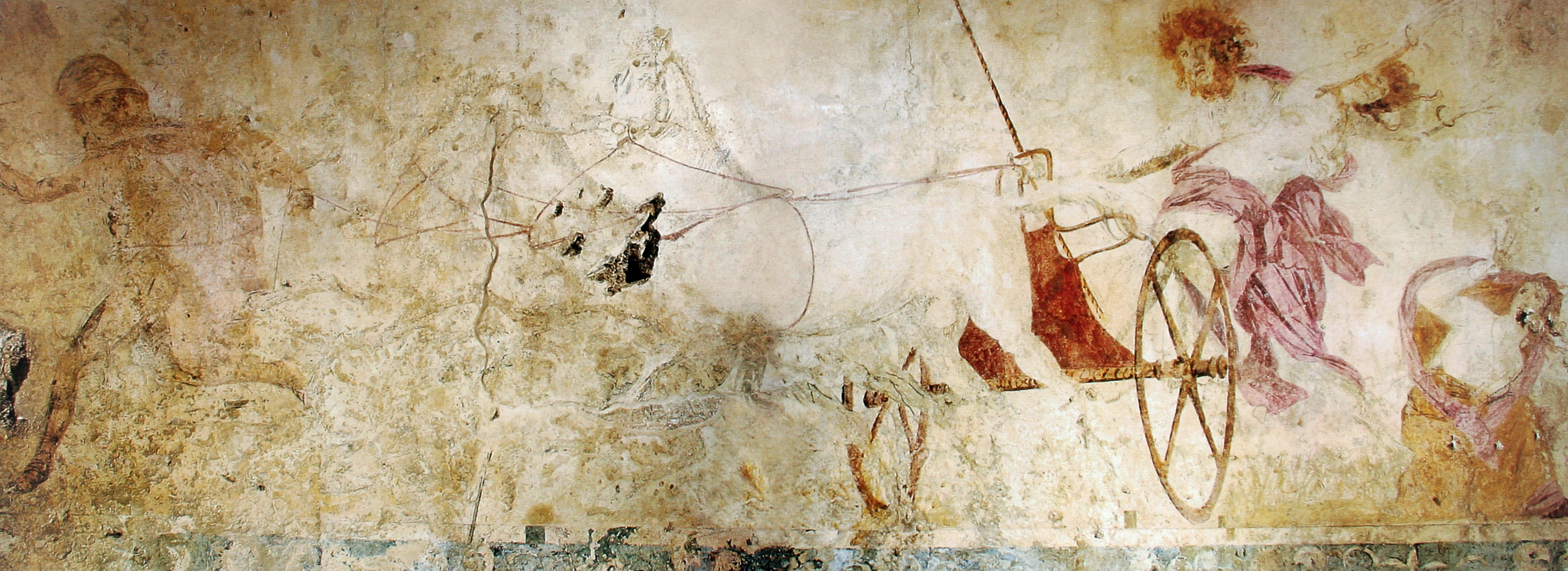
Unknown author, Public domain, via Wikimedia Commons
Homeric Hymn to Apollo
Apollo was the god of reason, prophecy, medicine, music, poetry, and many other things. Perhaps it’s unsurprising, then, that the hymn dedicated to him (Hymn #3) is a bit all over the place. In fact, some scholars believe that it was originally two hymns that got lumped together into one.
The hymn describes Apollo’s birth on Delos and then also explains how he came to establish his famous oracle at Delphi. We also hear how he kidnaps a group of merchants to be his priests (yep, you read that correctly).
Here are a few photos from Delphi, Greece. This city was the site of the oracle of Apollo (and it is the MOST beautiful place I have ever visited) .


Homeric Hymn to Hermes
This hymn (Hymn #4) is simply enchanting. Hermes is the god of thieves and trickery, among other things, so it makes sense that his entrance into the world of the Olympians was fraught with tension. If you think your toddler gets into trouble, then be thankful you don’t have a divine baby to deal with!
Within his first 24 hours, Hermes sneaks out of his cradle and invents a new musical instrument from a tortoise shell. If that isn’t impressive enough, he then causes an uproar by stealing his big brother Apollo’s cattle.
Read the hymn to get a full account of his shenanigans! Hermes’ mother Maia definitely had her hands full with this baby mischief-maker.

State Hermitage Museum, ГР-4162
Homeric Hymn to Aphrodite
The Hymn to Aphrodite (Hymn #5) is a bit different in that it almost mocks the deity it praises. Zeus is angry because Aphrodite keeps making him and the other gods fall in love with mortals, so he decides to teach her a lesson. He places in her heart an irrepressible passion for a mortal man, the Trojan prince Anchises.
Aphrodite is ashamed of her lust, but is nevertheless unable to resist the demeaning liaison. So this hymn gives us a seduction scene, and we also hear about the conception of Aeneas, the future founder of Rome.
You don’t want to miss this account of the goddess of love conquered by her own power!

William Blake Richmond, Public domain, via Wikimedia Commons
Go Read!
I hope that I have convinced you that the Homeric Hymns are worth a look! You can easily find a free translation on line. But if you would like a print version, I recommend the Oxford World’s Classics translation (available here on Bookshop and Amazon).
This edition includes a brief introduction, notes, and – most helpful of all – a glossary of names. So if you see “Slayer of Argos” and you have no idea what that means, never fear. The glossary will inform you that Slayer of Argos is a title of the god Hermes.
And if you have kids and would like to expose them to Greek myths in a more child-friendly form, then I recommend D’Aulaires’ beautifully illustrated Book of Greek Myths (available here on Bookshop and Amazon). Or you can just order the book for yourself and enjoy the images. Release your inner child!
Looking for more Greek mythology to read? Check out my post on Apollonius’ Argonautica and follow Jason and the Argonauts on their quest for the Golden Fleece.
YOU MAY ALSO LOVE:
Greek Tragedy: Don’t Miss These Iconic Myths

