
A Stone That Lies Still versus a Rolling Stone
Let’s examine two proverbs that deal with rocks! How does a Russian proverb involving a stone that lies still compare to the English adage about a rolling stone?
First we will look at the Russian proverb, which is probably less familiar to most of you. Then we will move on to discuss whether being a rolling stone is a good or a bad thing in English.
A Stone That Lies Still: Russian Proverb
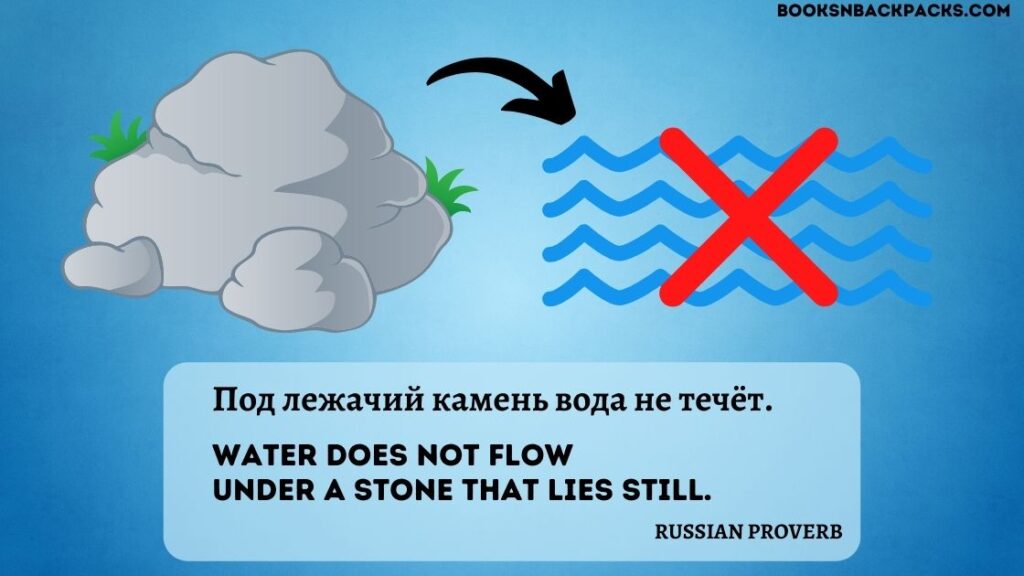
This Russian proverb urges us to take action and bring about the change we want to see in our lives. Don’t be a stone that lies still. Get up and roll onward!
Под лежачий камень вода не течёт.
Russian Proverb
Water does not flow under a stone that lies still.
Let’s say your friend wants to become a bestselling author, but they keep procrastinating and never even pick up the pen. You can say to them, “Water does not flow under a stone that lies still.”
This means – get up and do something about your dreams. Nothing will happen if you don’t take action. Water doesn’t flow under stationary stones, and water here is synonymous with progress.
In English, we might say, “No pain, no gain.” Or perhaps “Fortune favors the bold” or “God helps those who help themselves.” Even “Carpe diem” is relevant here!
A Rolling Stone Gathers No Moss: English Proverb
You may have heard the following English expression: “A rolling stone gathers no moss.” In this proverb, just like in our Russian one, the focus is on the motion (or lack thereof) of a rock. But what does it mean? Is it good or bad to be a rolling stone?
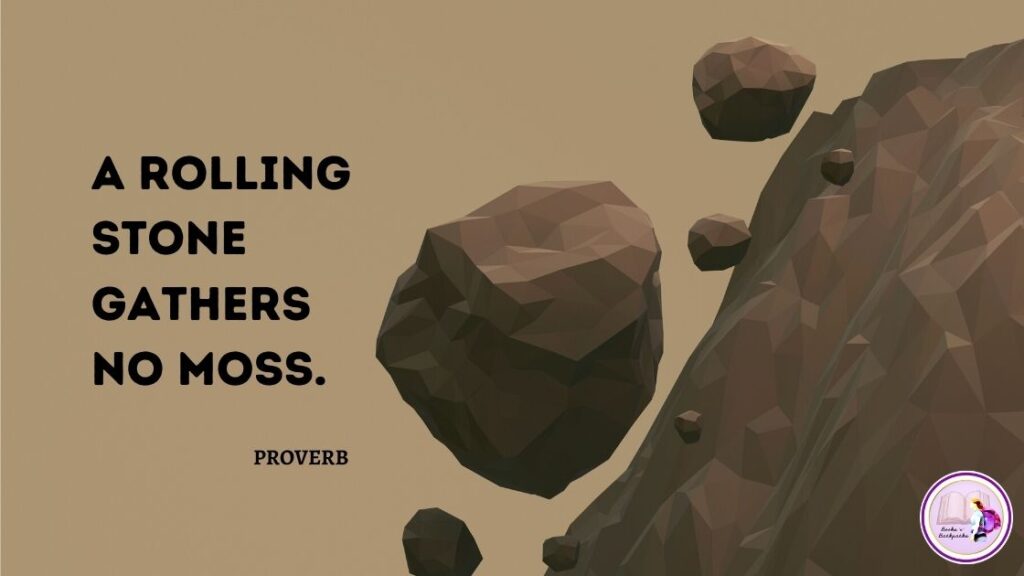
Is it good to be a rolling stone?
I was quite confused myself when I tried to determine whether rolling is positive or negative. My gut reaction was that gathering moss is bad. Moss, in my interpretation, represents stagnation and lack of progress. You should move on, down the hill, and roll onward to new experiences and opportunities.
In this understanding of the rolling stone proverb, it has the same basic meaning as our Russian saying about water and stones that lie still. Action! Be a rolling stone! Let the water flow!
But the more I thought about it, the more I remembered hearing about rolling stones as being a bad thing. You can use this expression to indicate that someone is irresponsible and lacks roots. They never make anything of their life, because they never stay put in one place and fight for anything.
In this interpretation, being a rolling stone is bad, and moss represents wisdom and stability.
History of the Rolling Stone
So, what is the true meaning of this proverb? It turns out that originally, the saying was used to encourage people to settle down. In other words, being a rolling stone was not good. But in the 20th century, the meaning of the metaphor started to shift.
People began to use the image of the rolling stone to encourage adventure, growth, and reaching for new horizons. Today, younger generations will probably instinctively relate to this interpretation (as I did) and feel that staying still is bad. But the other option is still available.
If you would like to read more about the history of the rolling stone, Merriam Webster’s discussion is quite interesting. And please let me know in the comments how you interpret this phrase!
A Stone That Lies Still: A Call to Action
The rolling stone proverb may be ambiguous, but our Russian saying is not. It is a reminder to take action and try new things. Let the waters of adventure and renewal carry you away. Don’t be a stone that lies still; embrace healthy change!
What do you think of this Russian proverb? And if you enjoyed this mini-post, don’t forget to check out my other language tidbits!


Time and again I’ve had people tell me at me book signings that they have a wonderful idea for a mystery. “How much of it have you written?” I always ask.
To which they usually reply, “Well, nothing yet, but it’s a really great story.”
The difference between a published author and a wannabe is often a matter of butt-in-seat-and-pen-(or laptop)-in-hand.
Great point, Fran! Which reminds me that I need to get to writing . . .