
The Dangers of a Bear’s Favor: A Russian Proverb
Here’s a fun animal-themed Russian idiom with an ancient pedigree! Keep reading to learn about the dangers of a bear’s favor.
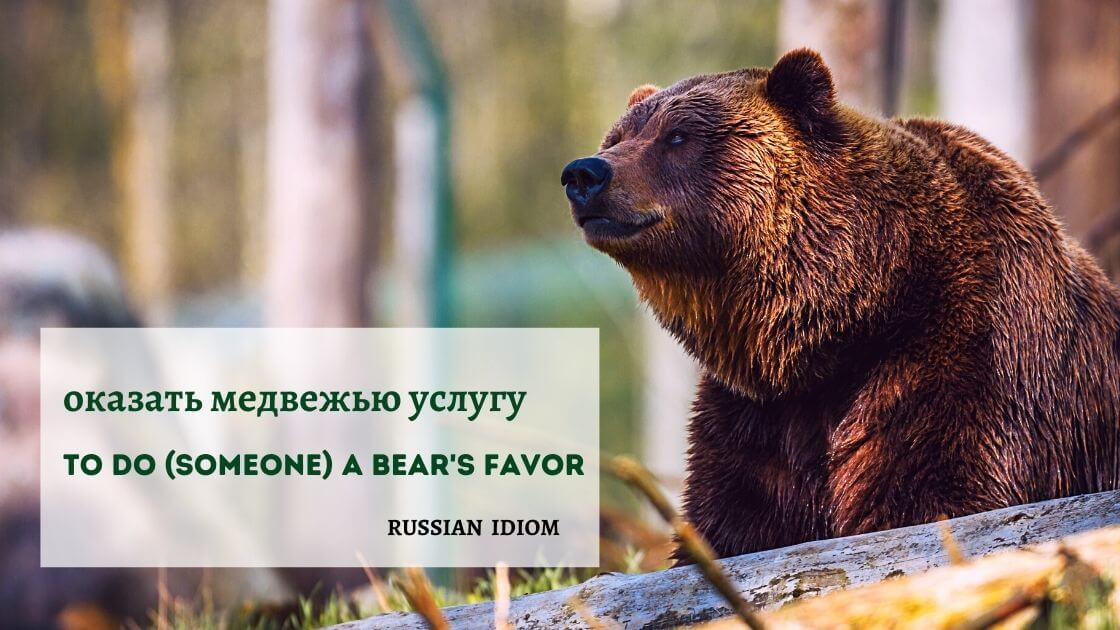
оказать медвежью услугу = to do (someone) a bear’s favor
What does this mean? Great question. The closest English equivalent would probably be “to do someone more harm than good”. And why, you may ask, is a bear’s favor such a terrible thing?
The expression goes all the way back to a story from the Panchatantra, a collection of Indian animal fables that is almost 2000 years old. One day a tired king commanded his pet monkey to ensure that no one disturbed him while he napped. As the king slept, a fly (or a bee) came along and buzzed around his face.
The monkey, trying to respect his master’s wishes, grabbed a sword and swung at the fly. The bug flew away unharmed, but the sword cut off the king’s head and killed him. And so the monkey’s good intention resulted in catastrophe.
Better a wise, learned man for a foe
Panćatantra p. 178, trans. Chandra Rajan (2007)
than an ignorant blockhead for a friend.
The robber for his victims gave his life;
the monkey killed the king.
Many other versions of the story circulated in ancient India and Persia. In the 17th century, the Frenchman Jean de La Fontaine included a variant in his Fables (VIII.10) and helped to make it popular in Europe. In La Fontaine’s adaptation, it is a bear who kills his friend the gardener with a stone when trying to chase away a pesky fly. The story of the ill-fated bear made it to Russia in Ivan Krylov’s Fables, and that is how we ended up with our modern phrase.
Regrettably, I haven’t read the Panchatantra myself (it is on my list!). But if you are a fan of fables, Penguin Classics has published an English translation. Check it out . . . and next time someone’s attempts to help do more harm than good, think of the poor monkey/bear!
Language Tidbits: Announcement!
Did you enjoy this discussion of a fun Russian idiom? Let me know in the comments. I would also like to take this chance to introduce a new section of the site: Language Tidbits. This section will feature (very) short posts about proverbs, idioms, and fun etymologies.
Background photo credit: Janko Ferlič on Unsplash


Thanks for the explanation of this adage. I’ll look forward to reading more language tidbits.
I am glad you enjoyed the explanation, Fran! Exploring fun/unusual idioms and proverbs is one of my favorite parts of language learning 🙂