
Eagles Fly Alone: Soar High & Make Your Own Path
This Polish proverb is an encouragement to be your truest self. Eagles are daring and fly alone, so it’s time to embrace your inner eagle!
Orły latają samotnie, tylko barany chodzą stadami.
Polish Proverb
Eagles fly alone; only sheep walk in herds.
What does it mean to say that eagles fly alone? I think the point of this proverb is pretty clear. The brave, bold eagle ventures out on its own, while sheep huddle together and are too afraid to separate from the crowd.

We can read this as more than just a description of animal habits. It is also a message that it is okay to be different.
It’s okay to make your own path and fly alone like the eagle. In fact, those who dare to defy convention are those who change the world. For if no one ever tried anything new, we would never have progress.
So next time you see an eagle flying alone in the sky, feel inspired! And now let’s talk about how sheep and eagle stereotypes have developed through the ages.
Sheep vs. Eagle: Animal Stereotypes
The animal stereotypes employed in this Polish proverb should feel familiar. Sheep don’t have the best reputation in English idiom, either, after all. If someone is “sheepish”, it means they are awkward, uncomfortable, embarrassed. Certainly not very positive!
Even worse, those who follow a leader blindly and trust in him or her without questioning are labeled “sheep”. In the political arena, where people with opposing viewpoints often accuse each other of naivete, being a sheep is equivalent to being brainwashed.
According to Etymonline, the meaning of “sheep” as a “stupid, timid person” goes all the way back to the 1540s. We have been calling each other sheep for a LONG time!
It isn’t hard to determine where this conception of sheep as timid or stupid came from, and why it appears in multiple languages and cultures. Sheep do, in fact, stay in herds (so much so that the “lost sheep” who has strayed from its herd is a Christian symbol of someone in dire danger). Sheep need their shepherds and sheepdogs to protect them, and sheep follow trustingly. They also make funny “baaa” noises. All in all, the sheep typically does not cut a very impressive figure.
The situation is entirely the reverse with eagles. We conceptualize them as majestic hunters, soaring high in the sky and dominating the air. They look powerful, fierce, and bold – it’s no wonder that they have appeared as symbols of courage for centuries. I mean, just look at this photo!

Photo used by permission of John Deitsch
Eagles Flying Through History
It would be impossible to list all the countries and people who have associated themselves with eagles. But I will give a few examples just for fun. Once you start to look, you see eagles EVERYWHERE.
I’ll begin with the Greek god Zeus and his Roman counterpart Jupiter. As king of the gods, Zeus deserved a mighty bird for his symbol, and the ancient peoples thought an eagle was the way to go.
Zeus sent omens in the form of eagles, and sometimes he transformed into an eagle himself. Most famously, he took the form of an eagle to abduct the young boy Ganymede to be his cupbearer and lover. (Yeah, Zeus wasn’t a great guy.)
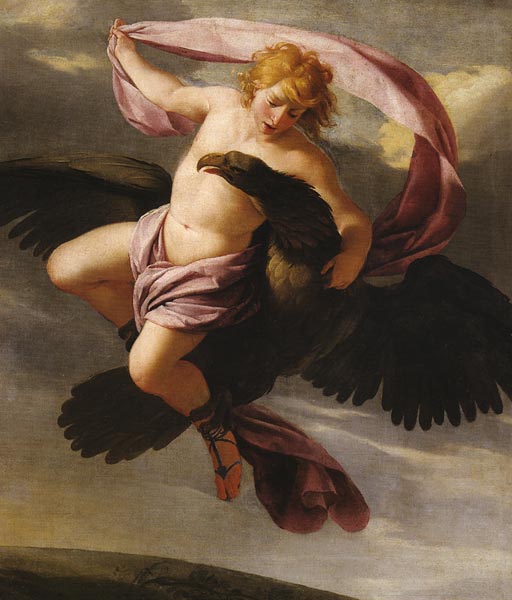
Eustache Le Sueur; Public domain, via Wikimedia Commons
Rulers throughout history have used the eagle to associate themselves with Zeus/Jupiter, the ultimate king, or simply with kingship in general. We frequently encounter the eagle in the heraldry of empires. The Holy Roman Empire and the Russian Empire are two excellent examples. The eagle’s two heads represent the expansion of the empire both east and west.

David Liuzzo, eagle by N3MO, CC BY-SA 3.0, via Wikimedia Commons

State Hermitage Museum, St. Petersburg, Russia
And, since our discussion began with a Polish proverb, we mustn’t forget that the eagle is also the symbol of Poland. It appears on Polish coinage and the Polish coat of arms, and was used as far back as the end of the 10th century. According to Polish tradition, an eagle showed the legendary founder Lech where to build Gniezno, Poland’s first capital.

Public Domain, via Wikimedia Commons
Finally . . . the bald eagle is the national bird of the United States. Check your pockets for change; if you have any quarters older than 1999, you will see the bald eagle on them!
Eagles Fly Alone
Since our Polish proverb is all about originality and striking out on your own, I feel like some inspirational music is appropriate. Here are two songs that will encourage you to forge your own path and embrace your inner eagle.
I hope that you have enjoyed my thoughts on this Polish proverb and the presence of eagles in history. Now you know the meaning of the phrase “eagles fly alone”!
Can you think of more examples of how eagles and sheep appear in culture and language? Let me know in the comments! And be sure to check out the rest of my language tidbits!
Background photo credit: Thank you to John Deitsch for letting me use this amazing photo of a bald eagle, taken in Bar Harbor, Maine. John is an undergrad studying entomology and biological sciences at Cornell University. You can follow him on Instagram at @deitsch_photography or check out his website for more nature-themed photos.


Ironically, Benjamin Franklin through our national bird should be the wild turkey rather than the eagle, which he considered a bird of less than stellar habits.
Ooh, what a great anecdote! I guess wild turkeys just didn’t seem as impressive to everyone else and so Franklin was overruled. Although I must say, there are a lot of turkeys wandering around the Harvard campus and they can be quite intimidating.
Thank you! Yes! I am an Eagle! I can fly alone with head up! I dont care about those sheeps! May they rest in peace! 🦅👊🏻