
Make Sure You Distinguish Elephants and Flies
What do elephants and flies have in common? Not much, and that is exactly the point in today’s fun idiom.
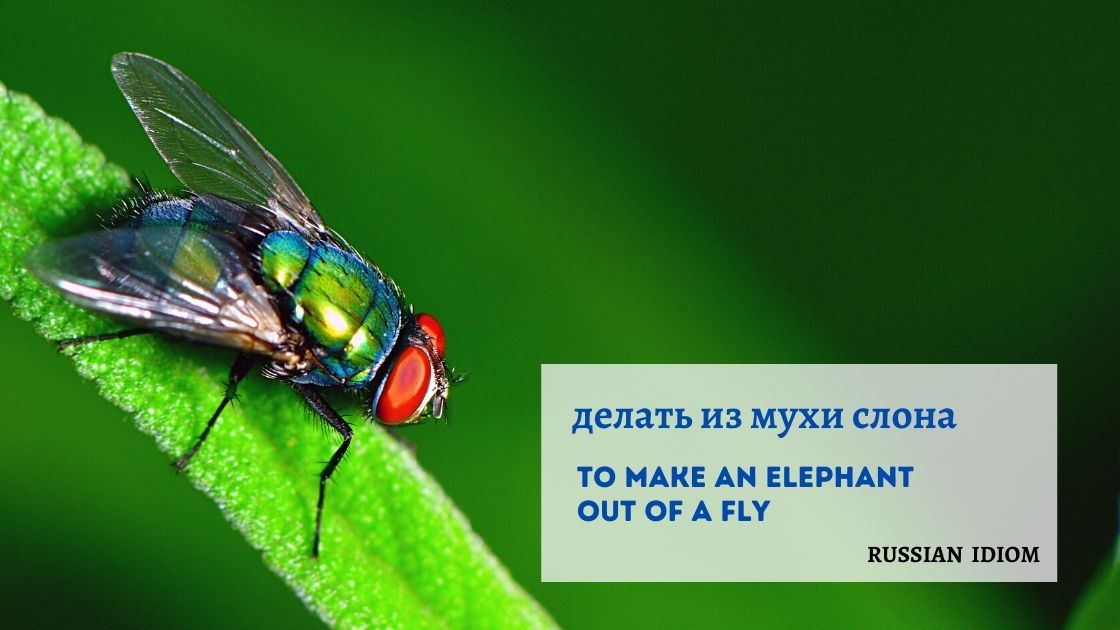
делать из мухи слона
Russian Idiom
to make an elephant out of a fly
As you might be able to guess, this is the Russian equivalent of making a mountain out of a molehill. (Or creating a storm in a teacup!) In other words, this is a way of speaking about extreme exaggeration. The same idiom also appears in French, German, and a few other languages as well.
French: faire d’une mouche un éléphant
German: aus einer Mücke einen Elefanten machen (except here our tiny bug is a mosquito, not a fly)
Why elephants and flies?
The precise origins of this expression are lost in the mists of time, but we know that people have been turning flies into elephants for almost 2000 years. In fact, the first known instance of the phrase appears in the writings of Lucian.
Lucian (ca. 125-180 CE) was a satirist from Samosata, a city in the Roman province of Syria (now Samsat in eastern Turkey). One of his works, aptly entitled The Fly, is a satirical piece in honor of – you guessed it – flies. After many paragraphs of effusive praise for the little bugs, Lucian concludes with the following statement:
But although I still have a lot to say, I will end my speech, lest I seem—according to the proverb—to make an elephant out of a fly.
Original (Ancient) Greek: πολλὰ δ᾿ ἔτι ἔχων εἰπεῖν καταπαύσω τὸν λόγον, μὴ καὶ δόξω κατὰ τὴν παροιμίαν ἐλέφαντα ἐκ μυίας ποιεῖν.
Lucian, The Fly, paragraph 12
This citation from Lucian proves that our idiom dates back to at least the 2nd century CE. It would seem that exaggeration has been a problem for a long time!
And speaking of exaggeration: if you have time, I recommend that you read the full text of Lucian’s very short and highly amusing encomium of the fly.
Lucian’s Opinion of Flies
Among other things, Lucian praises the buzzing sounds that flies make, emphasizes their sexual prowess, and uses them to defend the existence of the soul. He also describes how flies came into existence; the story involves the transformation of a poor young maiden who fell in love with the wrong man.
Finally, Lucian points out one way in which elephants and flies actually are alike. Go read his encomium to find out this unexpected similarity!
You can read the full text of The Fly online. But beware – they have translated the final lines (the ones quoted above) in a very non-literal way. As a result, they have removed the reference to turning flies into elephants, which frustrates me immensely! Alas, I was not able to find an accessible online translation that preserves the sense of the original Greek in this final line.
In conclusion . . .
If you enjoyed this post, check out my Language Tidbits section to learn about more fun proverbs and sayings. And please do share in the comments if you can think of any other idioms related to exaggeration!
Background photo credit: Juan Pablo Mascanfroni on Unsplash


Thanks for including the link to Lucien’s Encomium. I love the line where he said, “it annoys the elephant by getting into the folds of its hide, and letting it know the efficiency of even a tiny trunk,” thus backing up his own comparison of fly and elephant.
Delightful!
I’m so glad you enjoyed Lucian’s Encomium, Fran! I love that line, too 🙂
A someone who only knows English and Spanish, I’ve never heard this phrase before! Thank you for sharing and giving so much detail to its background
I’m happy I could introduce you to a new phrase, Celeste!
Learned something new today, and it kind of gave me a giggle. Thanks!
I’m so pleased to have provided some amusement, Jessica!