
No Mooing: When You Should Silence Your Cow
What do cows and judgment have to do with each other? In this post, we will look at a fun Russian saying before moving on to a consideration of its English equivalents.
Here’s the gist of it: no mooing if you live in a glass house! (How’s that for an interesting blend of expressions?)
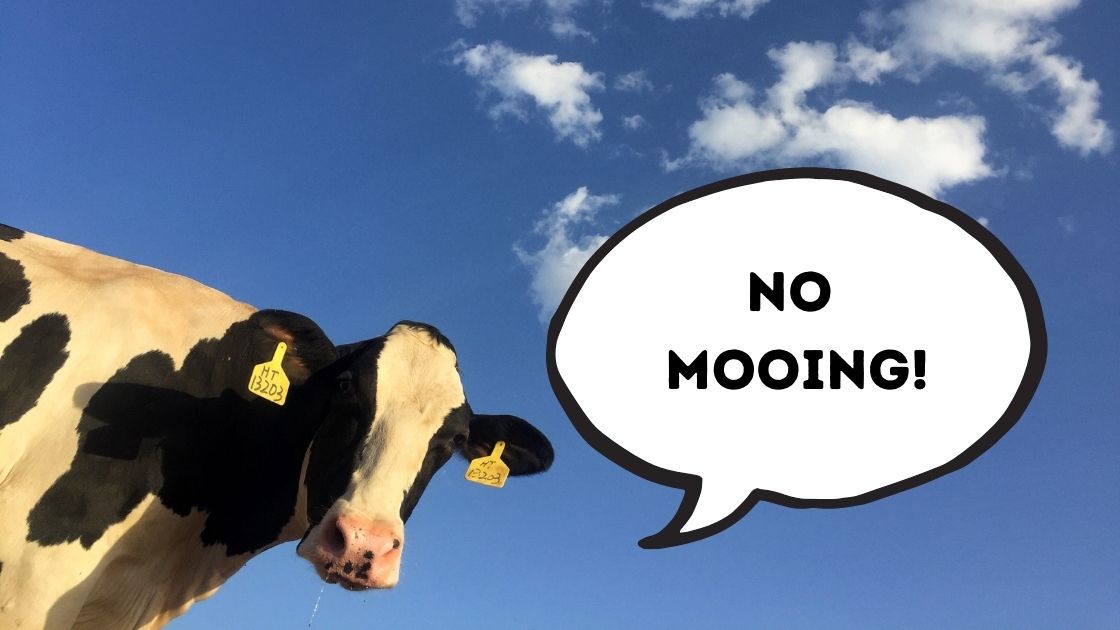
The Russian Version: No Mooing!
Чья бы корова мычала, а твоя бы молчала.
Russian Saying
Whosever cow moos, yours should be silent.
This saying is a variation on the age-old sentiment: don’t criticize someone else for something you yourself are guilty of.
For example, if I start complaining about how my friend is always late, my sister could say to me: “Whosever cow moos, yours should be silent!” In other words: “Look who’s talking!” The implication is that I, in fact, am often running behind myself and so have no right to grumble about my friend’s tardiness.
A tip for Russian learners: people often just say the first part of the sentence. “Чья бы корова мычала!” you interject, and your interlocutor knows that you are calling them out on their own less than ideal behavior.
If you are in a more formal context and you do want to use the entire phrase, remember to replace the informal possessive твоя with the formal ваша. (Although I would exercise caution in using this phrase outside of friends and family!)
Origins of the Phrase
Where does this expression come from? According to the various Russian magazines that I consulted, it dates back to the times of Kievan Rus’. Kievan Rus’ (the state to which Russia, Belarus, and Ukraine attribute their cultural origins) existed from the late 9th to the mid-13th century CE. So if the magazines’ claims are true, this saying is VERY old.
The story goes as follows. In the Middle Ages, people believed that droughts and bad harvests came from God as a punishment for sin. Since humans were hopelessly sinful, they decided that God would be more inclined to listen to the prayers of innocent cattle.
And so, whenever there was some sort of harvesting crisis, the farmers would lock their livestock away. The poor animals would grow hungry since they weren’t let out to pasture, and consequently they would begin to low. These moos were their prayers on behalf of their owners.
Everyone kept their cattle inside, even those who were affluent and had no need to worry about drought or famine. They didn’t need their cows’ intercession, so their less fortunate neighbors would say, “Your cow shouldn’t moo!”
That is, you are already in an excellent position. You don’t need anything else, you shouldn’t complain, no mooing for you! Gradually, the saying acquired the modern meaning that we discussed above: you shouldn’t complain about someone else’s fault when you are guilty of the same thing.
This is a fascinating derivation, and I very much hope that it is true. I was not able to find any scholarly sources on the subject, but this is the most popular explanation. In the absence of contradictory evidence, I will accept it.
English Variants: Pots, Kettles, & Glass Houses
I love the Russian formulation because it presents such a vivid image. You can imagine yourself in the countryside, surrounded by cows, some of which are lowing and some of which remain conscientiously silent.
But let’s not forget that we have many fun expressions condemning hypocrisy in English, too. Time to look at other ways of saying “no mooing!”
If that isn’t the pot calling the kettle black!
According to Etymonline, this phrase dates to around 1700 CE. In my opinion, it is the most well-known of the English versions – or at least, I certainly hear it all the time. Now it has even mutated into shortened colloquial forms like, “Pot, meet kettle.”
Those who live in glass houses should not throw stones.
This is the proverb that I alluded to at the beginning of this post with my mish-mashed statement, “No mooing if you live in a glass house!” The earliest attested form is in Geoffrey Chaucer’s Troilus & Criseyde (late 14th century CE).
And forthi, who that hath an hed of verre,
Troilus & Criseyde, Book 2, stanza 124, v. 867-868
ffro caste of stones war hym in the werre.
If you have no idea what those verses mean, don’t worry – I don’t understand them either. I just put the quote in the original Middle English to demonstrate how much English has evolved in the last six and a half centuries.
Modern translation: “Whoever has a head of glass should beware of casting stones.” At some point, the glass head became a glass house; Etymonline says the first recorded instance of our modern phrase is in 1779.
Bible Verses
Before we close, let’s look at two famous injunctions to self-reflection. Bible verses aren’t proverbs, of course, but in some parts of the world they circulate just as widely. Christians and non-Christians alike have probably heard the following two quotes at least once or twice.
Ὁ ἀναμάρτητος ὑμῶν πρῶτος ἐπ’ αὐτὴν βαλέτω λίθον.
John 8.7
Let whichever of you is free from sin cast the first stone at her.
Jesus speaks this line to the scribes and Pharisees when they want to condemn a woman caught in adultery. The message is clear: everyone has faults, so we should not judge one another. Just because the adulterous woman’s sin has been revealed does not make it worse than everyone else’s hidden faults.
ὑποκριτά, ἔκβαλε πρῶτον ἐκ τοῦ ὀφθαλμοῦ σοῦ τὴν δοκόν, καὶ τότε διαβλέψεις ἐκβαλεῖν τὸ κάρφος ἐκ τοῦ ὀφθαλμοῦ τοῦ ἀδελφοῦ σου.
Matthew 7.5
Hypocrite, remove first the beam from your own eye, and then you will see well enough to remove the speck from your brother’s eye.
Jesus doesn’t pull any punches in this passage from the Sermon on the Mount. Don’t judge, he says, or you are a hypocrite. Or, as they would say in Russia – tell your cow to shut up!
In Conclusion: No Mooing
I hope you have enjoyed my cow-induced musings on tolerance and compassion! For centuries, it seems, we humans have sought innovative ways of reminding each other not to overlook our own flaws. At the same time, these expressions also suggest that we look beyond ourselves and consider the needs of others.
This post features the proverbs and quotes that are familiar to me, but there are many more equivalent ones out there from all around the world. If you know of relevant sayings from different cultures, languages, and time periods, please share in the comments!
And if you enjoyed this post, check out my Language Tidbits section for more fun phrases and etymologies.
Background photo credit: Ryan Song on Unsplash


I like the Russian version best. Thanks for explaining the origins. My new favorite admonition is “No mooing!” 🙂
Hi Rachel! I’m glad you like “No mooing!” I feel like it could be a helpful phrase in many contexts. 🙂