
13 Awesome Latin Mnemonics: Improve Your Memory Today
If you struggle with Latin endings and rules, these handy mnemonics will make your life so much easier.
Mnemonics – or memory aids – use patterns and associations to trigger the recall of grammatical forms and principles. For example, “we fear a giant liar” summarizes the vowels appearing in the Latin present subjunctive.
Sometimes your brain needs an extra boost. Rhymes, acronyms, and other aids can be lifesavers.
Prepare to revolutionize your memorization and study process! This list includes all the Latin mnemonics that have been most helpful for my students.

This post may contain affiliate links and I may receive a commission, at no extra cost to you, if you make a purchase through a link. See my disclosures for more details.
The following memory aids are organized roughly in order of grammatical difficulty. That is, I start with mnemonics for basic concepts and then progress to ones about subjunctives, gerundives, etc.
1. Never Gag Down An Ant (Violently)
Do you struggle to memorize the order of Latin cases? Then this memorable sentence can help you out.
The first letter of each word in “Never gag down an ant” stands for a case. N for nominative, G for genitive, D for dative, A for accusative, and another A for ablative.
When I taught this to my beginning Latin students at Harvard years ago, they decided to add “violently” with a V for vocative.
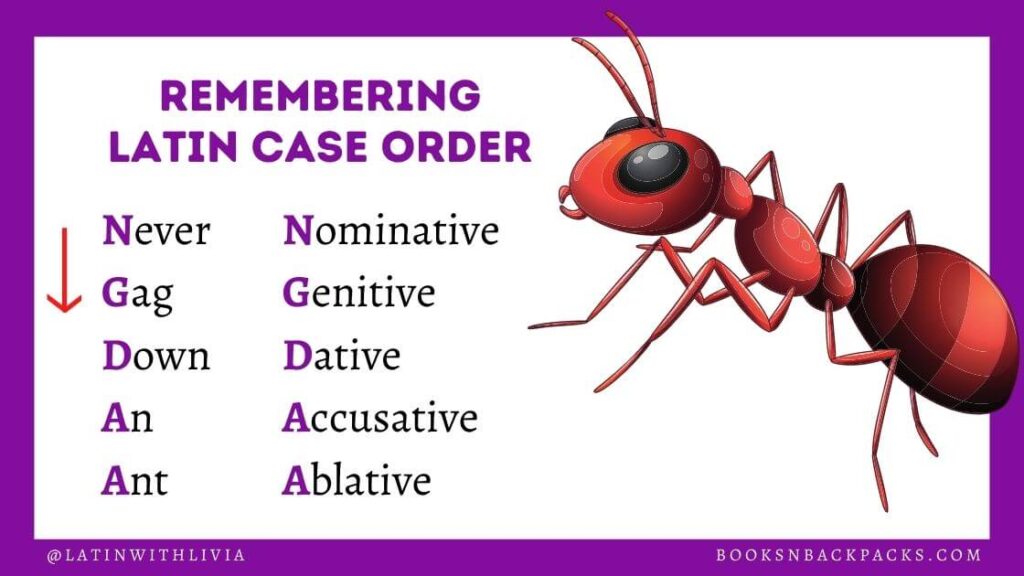
This sentence works for the standard order of cases presented in most American textbooks. If you learned the cases with accusative second, try to make up your own sentence to help you remember the order.
2. PAIN: 1st Declension Masculine Nouns
Most 1st declension Latin nouns are feminine, but there are a few exceptions that are masculine. You can remember four common masculine nouns of the 1st declension with the acronym P.A.I.N.
This is perhaps appropriate because these nouns are a pain for beginning students . . .
P: poēta = poet
A: agricola = farmer
I: incola = inhabitant
N: nauta = sailor
I first learned this memory aid from Shelmerdine, the textbook that I taught with at Harvard. But like most Latin mnemonics, it has been floating around in the Latin teacher community for years and years.

3: Neuter Plurals End in A
Time for our first (but not last) rhyme! Latin noun endings can seem overwhelming, which is why the neuter plural rule is like an anchor in a storm.
All neuter nouns, no matter their declension, end in –a in the nominative and accusative plural.
The plural of verbum, ī “word” (2nd declension) is verba. The plural of nōmen, nōminis “name” (3rd declension) is nōmina. And so forth.
Some enterprising Latin teacher came up with the following jingle:
Remember, remember, every day:
Neuter plurals end in A!
It’s simple, but crucial. Sing this out loud to yourself until the concept has sunk into your brain.
4. ERROR, SOX, and LANCET
The gender of 3rd declension Latin nouns is highly unpredictable. The best quick hack that I have found comes from Henle Latin, the textbook that I learned Latin from in middle and high school.
Noun gender is tough, so none of these mnemonics are foolproof. In fact, some might argue that they are mostly ineffective. But I think they can be a good starting point.
ERROR
3rd declension nouns ending in -er or –or (ERROR) are typically masculine. Examples are imber (heavy rain), amor (love), dolor (pain), and victor (conqueror).
I find that ERROR is most helpful for –or. There are lots of exceptions that I could name off the top of my head, though. For example, aequor (sea) is neuter.
SOX
3rd declension nouns ending in –s, –o, or -x (SOX) are typically feminine. Examples are urbs (city), ratiō (reason), and nox (night).
I am a big fan of SOX, but this rule does need to be qualified.
Feminine nouns ending in O will typically have –iō in the nominative singular and –iōnis in the genitive singular. Or they will have –ō in the nominative singular and –inis in the genitive singular.
- legiō, legiōnis, f. = legion
- magnitūdō, magnitūdinis, f. = greatness
- imāgō, imāginis, f. = image, form
There is one glaring exception to SOX: neuter nouns that end in –us in their nominative singular and –eris / –oris in their genitive singular. Here are some examples:
- corpus, corporis, n. = body
- tempus, temporis, n. = time
- genus, generis, n. = origin, lineage
But if you steer clear of these neuter nouns, SOX will serve you well.
LANCET
If a 3rd declension noun ends in –l, –a, –n, –c, –e, or –t (LANCET), there is a good chance that this noun will be neuter.
- animal, animālis, n. = animal
- poēma, poēmatis, n. = poem
- flūmen, flūminis, n. = river
- lac, lactis, n. = milk
- mare, maris, n. = sea
- caput, capitis, n. = head
⚠️ WARNING⚠️: Remember, the gender of 3rd declension nouns is highly unpredictable. The safest course of action is to add each noun’s gender to your Latin flashcards and memorize it.
Over time, you will pick up on more and more patterns. After years of learning and teaching Latin, I can reliably guess most nouns’ genders.
For a more intensive discussion, I recommend sections 84-87 of Allen and Greenough’s, my favorite Latin grammar.
5. Bo-bi-bu in 1 and 2: Future Tense Help
The future tense can be a stumbling block for Latin students. Why? Because the 1st and 2nd conjugations form their future in one way, while 3rd and 4th conjugations use a totally different way.
This rhyme is a gamechanger:
Bo-bi-bu in 1 and 2,
A and E in 4 and 3.
Pronounce bu as “BOO” to get the full effect.

To understand the significance better, let’s take a look at a verb chart.
| Person & Number | 1st & 2nd Conj. (bo bi bu) | 3rd & 4th Conj. (A and E) |
|---|---|---|
| 1st sing. | –bō | –am |
| 2nd sing. | –bis | –ēs |
| 3rd sing. | –bit | –et |
| 1st plur. | –bimus | –ēmus |
| 2nd plur. | –bitis | –ētis |
| 3rd plur. | –bunt | –ent |
Do you see the bo, all the bis, and the bu in the 1st and 2nd conjugation column? How about the A and all the Es in the 3rd and 4th conjugation column?
I put them in blue to draw your attention.
One thing I like a lot about this memory aid is that it helps with the vowel patterns, too. The bo bi bu reminds you that the future tense marker –bi– changes in the 1st person singular and 3rd person plural.
Speaking of vowel patterns . . .
6. Ham and Five Eggs: More Future Tense
The future tense of 3rd and 4th conjugation verbs can be a pain to remember – but not any more!
My assistant teacher at Kenyon College taught me this memory aid and it’s been a huge help to my beginning Latin students ever since.
In the future tense, 3rd and 4th conjugation verbs have a 1st person singular ending in –am (ham). Then the other forms all have Es: ēs, et, ēmus, ētis, ent (five eggs).
Ham = am
Egg #1 = ēs
Egg #2 = et
Egg #3 = ēmus
Egg #4 = ētis
Egg #5 = ent
Just imagine someone eating a hearty breakfast and you will be set.
My students particularly love this mnemonic. They always write “ham and five eggs” at the top of their quizzes and tests to remind themselves of the vowel pattern.
7. Dūc, dīc, fac, and fer: Irregular Imperatives
Latin imperatives are usually simple, but four common verbs have irregular command forms.
- dūcō, dūcere = lead
- dīcō, dīcere = say
- faciō, facere = do, make
- ferō, ferre = bring, carry
The standard 2nd singular imperative ending for 3rd conjugation verbs is –e. Thus we would expect *dūce, *dīce, *face, and *fere.
Instead, we get dūc (lead!), dīc (say!), fac (do!), and fer (bring!).
The following rhyme can help you remember these irregular forms.
Dūc, dīc, fac, and fer:
should be an E, but it isn’t there.
The expected E has disappeared, hence the rhyme!
8. We Fear A Giant Liar / She Wears A Diamond Tiara
The Latin subjunctive mood is tough for students to master. There are just so many different uses!
Furthermore, the present subjunctive can be a hard tense to memorize due to its vowel patterns. Luckily, there is an easy fix for this second challenge!
Latin students and teachers have come up with a myriad of short sentences that reflect the vowels found in each conjugation.
1st conjugation verbs have e, 2nd conjugation verbs have ea, 3rd conjugation verbs have a, and 4th conjugation verbs have ia. 3rd i-stem verbs also have ia.
I will teach you two of these sentences here. First is “We fear a giant liar” and second is “S/he wears a diamond tiara”.
We ➡️ E for 1st conjugation
fear ➡️ EA for 2nd conjugation
a ➡️ A for 3rd conjugation
giant ➡️ IA for 3rd i-stem
liar ➡️ IA for 4th conjugation
This is my preferred sentence because every vowel has significance. But some of my students like “S/he wears a diamond tiara”, so I use that, too.
She ➡️ E for 1st conjugation
wears ➡️ EA for 2nd conjugation
a ➡️ A for 3rd conjugation
diamond ➡️ IA for 3rd i-stem
tiara ➡️ IA for 4th conjugation
For this mnemonic, you have to ignore the O in diamond and the second A in tiara.
My students love writing these sentences at the top of their quizzes and exams, too!

9. UNUS NAUTA aka the “Naughty Nine”
There are nine 2-1-2 adjectives, sometimes dubbed the “Naughty Nine”, that follow a pronominal declension pattern.
Basically, this means that they have special genitive and dative singular endings: -īus in the genitive and –ī in the dative. These special endings apply for all three genders (masculine, feminine, and neuter).
“Special adjectives” cause confusion because their dative singular looks like a genitive singular. I still fall into this trap sometimes even after decades of learning Latin.
The acronym UNUS NAUTA (“one sailor”) can help you remember which adjectives have these unusual endings.
U: ūnus, a, um – “one”
N: neuter, neutra, neutrum – “neither”
U: uter, utra, utrum – “which; either”
S: sōlus, a, um – “alone; only”N: nūllus, a, um – “no, none”
A: alter, altera, alterum – “another; the other (of two)”
U: ūllus, a, um – “any”
T: tōtus, a, um – “whole, entire”
A: alius, a, um – “other”
I have always used UNUS NAUTA on its own, but I recently learned that the “Naughty Nine” or variations thereupon (“Nasty Nine”, etc.) are popular terms among Latin teachers. Something to incorporate into my Latin classes this semester!

10. DIRT: Nouns with a Locative Case
The locative case expresses the location where something is or occurs. But there’s a catch: the ablative has replaced the locative for most nouns.
Only small islands, cities and towns, and the nouns domus, rūs, and humus regularly employ the locative in classical Latin.
This is a bizarre list of items, but Elizabeth Manwell – a Classics professor at Kalamazoo College – has found a trick to remember them.
The acronym D.I.R.T. captures the scope of the locative case:
D: domus
I: islands (smaller than Rhodes)
R: rūs
T: towns and citiesD, I, R, and T spell “dirt”, and humus = dirt.
Elizabeth Manwell, shared in Latin Teacher Idea Exchange
Just think about dirt, and you are less likely to forget the types of nouns that have locative endings. These are also, incidentally, the nouns that do not require a preposition with the accusative of motion or the ablative of place-from-which.
11. PUFF-V: Deponent Verbs with the Ablative
Latin students learn early on that the direct object is in the accusative case. But there are some Latin verbs that require an object in the ablative case, instead.
These verbs are deponents and due to the quirks of their historical development, they can’t have an accusative object. Ablative to the rescue!
The acronym PUFF-V (pronounced “puffy”) can help you to remember the five most common “special verbs” with the ablative.
P: potior (take possession of, acquire)
U: ūtor (use, make use of)
F: fruor (enjoy, delight in)
F: fungor (perform, be engaged in)
V: vescor (feed on, eat)
I grew up listening to the song “Puff the Magic Dragon”, so this mnemonic resonates with me. This is another gem that I learned from the Latin Teacher Idea Exchange Facebook group.
If you would like to dive a bit deeper, my ablative guide has example sentences with special verbs so you can see ablative objects in action.
12. A gerundive is an adjective
Gerunds and gerundives are each confusing in their own right. It doesn’t help that they look similar in Latin (-nd– for the win) AND have related names in English.
Gerunds are verbal nouns, while gerundives are verbal adjectives. When I teach these forms, I always proclaim: “A gerundIVE is an adjectIVE.”
Make sure you say this loudly and emphasis the IVEs. The more passion you put into it, the better you will remember it.

I was once reading Sallust with a high school student and I taught him this mnemonic. “Wow, I will never forget this now!” he replied, and he didn’t.
He went from struggling to differentiate between gerunds and gerundives to correctly identifying them 100% of the time.
This was an exceptionally positive outcome, and this student already had several years of practicing with gerunds and gerundives under his belt. So don’t worry if you still get them confused!
Speaking of which . . . let me demystify gerunds and gerundives for you!
13. All the alis fly away
Indefinite pronouns in Latin often begin with ali-. Examples are aliquis (someone) and aliquid (something).
This helps us to distinguish indefinites from interrogative pronouns such as quis (who?) and quid (what?).
But after certain conjunctions, indefinite pronouns lose the ali-. These conjunctions are sī (if), nisi (if . . . not), and nē (in order that . . . not). Ali- also disappears after the adverb num (whether).
Compare the following two sentences:
#1: Aliquis apud tē cēnat. = Someone is eating dinner at your house.
#2: Sī quis apud tē cēnat, domī maneō. = If someone is eating dinner at your house, I stay at home.
Aliquis and quis are both equivalent here to English “someone”. But Latin convention dictates that quis, not aliquis, should appear after sī.
This may seem like an insignificant rule, but it can actually be a source of major confusion. Most students see quis and immediately think “who?” This means that sentences like #2 make little sense.
Luckily, there is an old rhyme to help us out!
After sī, nisi, num, and nē
all the alis fly away!
Next Steps: How To Use Latin Mnemonics
Latin memory aids will streamline your memorization process and make you feel more confident if you face exams or other assessments.
Don’t forget to repeat these mnemonics, especially the rhymes, out loud. This will help them stick in your brain.
If you are a student in a traditional Latin classroom, I highly recommend that you write relevant mnemonics somewhere on your quiz or exam sheet. Then you can refer back to them as needed.
It’s important to note, though, that memorizing grammar rules is not enough to master Latin. Ultimately, your goal should be to understand Latin instinctively, without having to run through declensions and conjugations in your head.
You can train yourself to read Latin in its natural word order, and the sooner you start, the better.
✨ Don’t miss my practical tips for reading Latin fluently! Learn how to combine your grammatical knowledge with helpful reading techniques. ✨
📚 I highly recommend Latin novellas as a way to kickstart your reading comprehension. My beginning Latin students read Ego Polyphemus, a retelling of Odysseus’ encounter with the Cyclops from the Cyclops’ perspective! 📚
YOU MAY ALSO LOVE:
My Favorite Resources for Latin Students (Free + Paid)
How To Pronounce Classical Latin
50+ Latin Phrases Used Everyday in English


Thank you so much Livia! These tips are amazing, especially since I am not learning in a typical classroom but am teaching myself Latin. I look forward to reading your emails every time they come through, & this one was phenomenally helpful!
Hi Addie, I am thrilled that you are enjoying my emails and that this post in particular has helped you out! Mnemonics can solve so many memory problems 🙂
Thank you for the resources that you provide! They are super helpful for my Latin instruction!
You are welcome, Vic! I’m glad to be of help 🙂