
Conversational Latin: Hello, I’m Sorry, & More Key Phrases
Are you wondering how to say “hello”, “thank you,” “I’m hungry,” and other crucial phrases in Latin? Dive into conversational Latin and learn how to navigate basic social situations.
Reading Vergil, Cicero, and Livy is great, but sometimes you just want to have a simple Latin conversation. And isn’t it odd that the average Latin student can read sentences all about war but has no idea how to say “thank you”?
We may associate Latin with textbooks, translation, and frustrating grammar rules, but it is good to remember that Latin was a living, breathing language. Times are changing and spoken Latin is making a comeback.
Let’s get started! Or shall I say – incipiāmus!

This post may contain affiliate links and I may receive a commission, at no extra cost to you, if you make a purchase through a link. See my disclosures for more details.
Conversational Latin Words & Phrases
Romans (and many other people all over the ancient Mediterranean) spoke Latin just as easily as we speak our native languages today. Surviving Roman comedies by Plautus and Terence are a brilliant source of this colloquial Latin.
And, as I mentioned above, spoken Latin is alive and well today. I can attest to this from having spent a full week speaking only Latin at the Conventiculum Bostoniense, a language immersion program run by UMass Boston.

Here are some of the things the Romans might have said to each other! Modern enthusiasts use these conversational Latin phrases everyday.
Greetings, Introductions, & Other Latin Pleasantries
These helpful phrases will prepare you for your first ever Latin conversation. You can use them to greet someone, introduce yourself, say goodbye, thank them, apologize, and more.
Quick Notes: In the Latin column on the left, you may notice that sometimes there are two options separated by a slash (e.g. salvē / salvēte). When this happens, the first form (salvē) is used when speaking to one person. The second (salvēte) is used when speaking to two or more people.
In the English column on the right, I give the idiomatic translation first and then the literal translation in parentheses. So, for example, salvē is the standard way to say hello in Latin, but the literal meaning is “be well!”
| Latin | English |
|---|---|
| salvē / salvēte | hello (“be well!”) |
| heus | hi, hello there (to get someone’s attention) |
| Quid agis? / Quid agitis? | How are you? (“What are you doing”?) |
| Bene | Good / Well |
| (Nōn) male | (Not) bad |
| Optimē | Very well / fantastic |
| Pessimē | Very bad / terrible |
| Ut valēs? / Ut valētis? | How are you? (“Are you well?”) |
| Valeō | I am well |
| Quid fit? | What’s up? (“What is happening?”) |
| Mihi nōmen est . . . | My name is . . . |
| Quid nōmen tibi est? | What is your name? |
| Volup est tē convēnisse / volup est vōs convēnisse | Pleased to meet you |
| valē / valēte | Goodbye (“Be strong!”) |
| Cūrā ut valeās! / Cūrāte ut valeātis! | Take care! |
| ita est | yes (“it is so”) |
| sīc est | yes (“it is so”) |
| minimē | no (“not at all”) |
| grātiās tibi agō / grātiās vōbīs agō | thank you (“I give thanks to you”) |
| grātiās | thanks |
| libenter | you’re welcome (“willingly”) |
| amābō tē | please (“I will love you”) |
| quaesō | please (“I beg”) |
| ignōsce mihi / ignōscite mihi | I’m sorry (“forgive me”) |
| ignōscō | that’s okay (“I forgive you”) |
Saying Hello in Latin: Salvē / salvēte is an imperative or command form of the verb salveō, salvēre, which means “be well” or “be in good health”. So when you say salvē to someone, you are literally commanding them to be well.
This is, incidentally, why salvē also can be used to say “bless you!” after someone sneezes.

Nice To Meet You: There is not an exact equivalent for this nicety in Latin. John Traupman uses mihi pergrātum est tē convenīre (“it is pleasing for me to meet you”) in his guide to oral Latin, but this phrase is not attested in classical Latin and in general I don’t like Traupman’s colloquial Latin choices.
I went with volup est tē convēnisse because in Plautus’ Miles Gloriosus a character exclaims, “Tē, Palaestriō, volup est convēnisse” (“It is a pleasure, Palaestrio, to have run into you”, 276-277). The problem is that this is not the first time these two characters have met, so the sense is a little different than in the English “nice to meet you”.
Another option is to say gaudeō “I rejoice / I am happy”, since this can cover a variety of situations. Or you can use the more complicated salvom / salvam (tē) vēnisse gaudeō (“I rejoice that you have arrived safely”), which has classical roots. Salvom is masculine and salvam is feminine.
This phrase could also mean “welcome!”, depending on the context.

Yes and No in Latin: You may have heard that Latin lacks a word for yes and no. This is true, strictly speaking, and I have a full post on this coming soon. But there are ways to affirm or deny a statement, and these are what I have listed above.
In modern spoken Latin circles we tend to use ita and minimē like “yes” and “no” even though this doesn’t truly fit with ancient Roman speech patterns.
✨ Psst! Are you looking for a good Latin dictionary? I don’t like Traupman’s oral Latin book, but his dictionary is fantastic.
This compact and affordable gem is my top recommendation for beginning Latin students! ✨
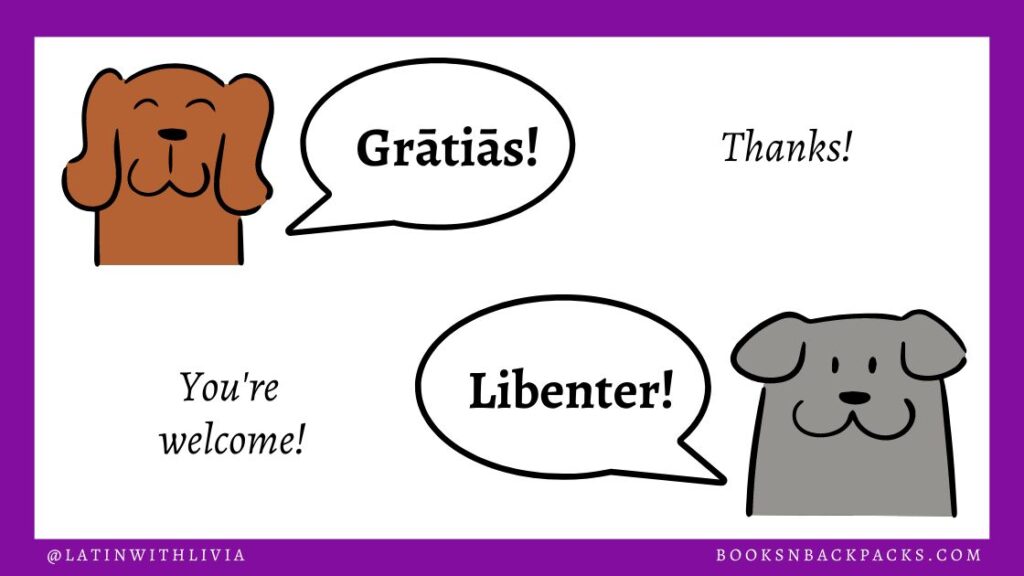
Saying Thank You: There were various ways to express gratitude in ancient Rome. Read my guide to thanking someone in Latin for more details!
It also covers different variations of “you’re welcome” (which the Romans did not have a set phrase for).
Talking about Yourself & How You Feel
Maybe you want to go beyond basic introductions and talk about your age, your home, or your hobbies. Or maybe you simply want to say how you are feeling right now!
This next list of everyday Latin phrases will help. I have also added some fun Latin exclamations at the end.
Quick Note: You will notice that the Latin column once again often has two words separated by a slash. This time, the first option is the masculine form of the adjective and the second is the feminine.
Grammatical gender is built into Latin adjectives. So, for example, if you are speaking to someone who uses masculine pronouns you will ask: Quot annōs nātus es? But if your interlocutor uses feminine pronouns, you need to say: Quot annōs nāta es?
The same applies when you are referring to yourself. I am a woman so I would say trīgintā annōs nāta sum, but my husband would say duōs et trīgintā annōs nātus sum.
| Latin | English |
|---|---|
| Quot annōs nātus / nāta es? | How old are you? |
| # annōs nātus / nāta sum – vīgintī – trīgintā – quinquāgintā | I am # years old – twenty – thirty – fifty |
| Ubi habitās? | Where do you live? |
| Habitō in – Ītaliā – Graeciā – Aegyptō – Cīvitātibus Foederātīs Americae | I live in – Italy – Greece – Egypt – the United States |
| Loquerisne latīnē? | Do you speak Latin? |
| . . . loquor – latīnē – graecē – anglicē | I speak . . . – Latin – Greek – English |
| Quid tibi placet facere? | What do you like to do? |
| Mihi placet . . . – cantāre – currere – itinera facere – librōs legere – linguās discere – mūsicam audīre – pelliculās spectāre – cum animālibus lūdere | I like (“it pleases me”) – to sing – to run – to travel (“make trips”) – to read books – to learn languages – to listen to music – to watch movies – to play with animals |
| ēsuriō | I’m hungry |
| sitiō | I’m thirsty |
| laetus / laeta sum | I’m happy |
| trīstis sum | I’m sad |
| fessus / fessa sum | I’m tired |
| aeger / aegra sum | I’m sick |
| Volō – iter facere – librum legere – cum amīcīs loquī – pelliculam spectāre | I want – to go on a trip – to read a book – to talk to my friends – to watch a movie |
| Nōlō – lūdere – saltāre | I don’t want – to play – to dance |
| ēheu | oh no! (exclamation of grief) |
| euge | well done! excellent! (exclamation of joy) |
| hahahae | hahaha (lol) |
Talking About Your Age in Latin: Simply insert the appropriate number into the formula # annōs nātus / nāta sum and you will be good to go. If you aren’t confident at counting in Latin, consult my post on Latin numbers to find your age!

Where You Live: I listed Italy, Greece, and Egypt as examples since these were important locations in the Roman world. And then I added the United States because that’s where I live.
To customize this expression for yourself, first you need to find the name of your country in Latin. Here’s a pro tip: you can go to the Wikipedia page for your country and then switch the language to Latin (Latīna) to see the Latin name.
(Yes, that’s right – Vicipaedia exists and can be a great resource for modern Latin!)
Once you know your country’s name in Latin, put it in the ablative case. Then you can add this case form into the formula habitō in X.
Hobbies & Wants: When you talk about what you like doing or what you want to do in Latin, you need to use an infinitive. Finding the infinitive is easy: it is a Latin verb’s second principal part.
Let’s say that you enjoy swimming. The verb “swim” is natō and the principal parts are natō, natāre, natāvī, natātus. Take the second form, natāre, and plug it into the formula to get mihi placet natāre “I like to swim”.
Do you want to talk about modern activities and things in Latin? In addition to Vicipaedia there is also the free online Neo-Latin Lexicon. The interface can be clunky, but you can look up pretty much anything you want.
I also want to recommend two Latin picture dictionaries. Pictures aren’t only for children – I love learning new vocabulary in this way!
- Anna Andresian’s Vocabula Picta is beautifully done and packed with information. Household items, sports events, technology, geography . . . you can find it all here.
- The Usborne First Thousand Words in Latin is another excellent option. It is also more easily accessible (Andresian’s dictionary goes out of stock periodically).
If you want to learn “modern” Latin vocabulary, I highly recommend one of these fun dictionaries.
Holiday, Birthday, and General Wishes in Latin
Sending well wishes in Latin can be a lot of fun. Here are some useful phrases for you!
The holidays listed are US-centric since these are the ones I am most familiar with. There are also a lot of Christian holidays since Latin is the official language of the Catholic Church.
If you have a holiday you would like me to add to the list, let me know in the comments.
| Latin | English |
|---|---|
| Fēlīcem diem nātālem | Happy birthday |
| Fēlīcem diem anniversārium | Happy anniversary |
| Tibi grātulor / vōbīs grātulor | Congratulations [to 1 person, to 2+ people] |
| Bonam fortūnam | Good luck |
| Annum novum faustum fēlīcem | Happy New Year |
| Fēlīcem diem Sānctī Valentīnī | Happy St. Valentine’s Day |
| Cavē Īdūs Martiās | Beware the Ides of March |
| Fēlīx Pascha | Happy Easter |
| Fēlīcem diem quārtum Iūliī | Happy Fourth of July |
| Fēlīcem diem lībertātis | Happy Independence Day |
| Fēlīx pervigilium omnium sānctōrum | Happy Halloween |
| Fēlīcem diem grātiārum āctiōnis | Happy Thanksgiving |
| Fēlīcem vigiliam nātālis Chrīstī | Merry Christmas Eve |
| Fēlīcem diem nātālem Chrīstī | Merry Christmas |
| Fēlīcem vigiliam annī novī | Happy New Year’s Eve |
Latin students may have noticed that all these phrases (except for tibi grātulor) are in the accusative case. This is because each holiday’s name is the direct object of an implied verb of wishing.
I talk about the grammatical options in more depth in my guide to saying Merry Christmas in Latin. There are various ways of sending season’s greetings, but I have put what I consider to be the most common version for each holiday.
BONUS TIP: Do you want to form a full sentence in Latin? You can add tibi exoptō (when speaking to one person) or vōbīs exoptō (when speaking to two or more people) at the end of the holiday phrase. Examples:
- Fēlīcem diem lībertātis tibi exoptō = “I wish you (singular) a happy independence day”
- Fēlīcem anniversārium mātrimonī vōbīs exoptō = “I wish you (both) a happy wedding anniversary”
If you would like to write a more personalized birthday greeting, check out my post on birthday wishes and customs in ancient Rome.

Final Thoughts on Conversing in Latin
As I mentioned earlier in this post, much of our evidence for casual Latin conversations comes from Roman comedies. Can you spot any of the new phrases that you have learned in this excerpt from Plautus’ Rudens?
Labrax. Adulēscēns, salvē. . . . Ut valēs?
Gripus. Quid tū? num medicus, quaesō, es?
Labrax. Immo edepol ūnā litterā plūs sum quam medicus.
Gripus. Tum tū mendīcus es?
Labrax. Tetigistī acū.Labrax: Hello, young man. . . . How are you?
Plautus Rudens 1303-1306
Gripus: What’s it to you? Are you a doctor (medicus), I ask?
Labrax: By Pollux I am more than a doctor by one letter.
Gripus: Then you are a beggar (mendīcus)?
Labrax: You’ve hit the nail on the head (you’ve touched [the situation] with a needle).
This conversation involves wordplay based on social conventions. Valeō, valēre literally means “be strong” or “be physically well”. When you ask someone ut valēs?, you are asking, “How strong / well are you?”
Gripus pretends to take the pleasantry as a literal inquiry into his health and asks if Labrax is a doctor. Joking commences from there.
This short excerpt packs in so many colloquialisms. At the end we get a Latin idiom – acū tangere, “to touch with a needle” – which means that someone is spot on. Cool, right?
I hope you will now enter Latin conversations with more confidence. Even if your primary goal is to read Latin comfortably, speaking out loud can help you so much.
In fact, some recent second language acquisition research suggests that pronounceability affects reading comprehension. So, in other words, the better you can pronounce Latin words, the better you can understand them as you read.
That’s why I always encourage my students to read Latin out loud and even respond aloud to questions in Latin as much as possible. Let’s view Latin as a language, rather than as a puzzle!
Bonam fortūnam in linguā Latīnā discendā!
YOU MAY ALSO LOVE:
My Favorite Latin Novellas for Beginners
50+ Latin Phrases Used Everyday in English


my father was in the seminary, ages ago, when they had to speak in Latin. My first year of Latin I floundered and his solution was to force me to converse in Latin. At first he corrected my mistakes, then we were equal, then I started correcting his mistakes!. I learned how to speak, write and eventually dream in common (not Classical) Latin. This was decades ago and I doubt I could still converse, but it can be done
What a great story, Tom! Sometimes “activating” Latin skills by speaking (or by writing) is what really makes things click. Even a little bit of conversation can go a long way.
I have to compose so much Latin for my students, often on the fly in the classroom, and I also have a habit of reciting Latin poetry aloud to myself. I think these two activities were what enabled me to transition into speaking Latin without too much difficulty. I had never prioritized conversational Latin until a few years ago when I signed up for a weeklong immersion program. Talk about diving into the deep end! I was nervous, but it ended up being so much fun.
Fascinating! I did wonder whether you were already prioritizing conversational Latin with your students before you joined the immersion program. Thanks to both your and Tom’s stories, it feels a bit more doable now.