
Latin Indirect Statements: Accusative & Infinitive Explained
Are you bewildered by the accusatives and infinitives popping up everywhere in Latin sentences? If so, this guide to Latin indirect statements is just what you need.
When reading Latin, you will encounter sentences like the following:
Putō tē bene scrībere. = I think that you write well.
When you analyze the Latin, you will discover that tē is in the accusative case and scrībere is an infinitive. An extremely literal translation into English would be “I think you to write well.”
This sounds awkward in English, but it is perfectly natural in Latin. The accusative-and-infinitive combination is the backbone of the Latin indirect statement.
It is essential for you to master this construction, and this post will walk you through the most important details!
What is an indirect statement?
Before we get into the weeds of Latin grammar, let’s go over some terminology.
Indirect discourse, also called indirect speech or reported speech, is when someone’s words, thoughts, or observations are reported indirectly, through paraphrasing – that is, not verbatim.
Imagine that my friend says to me, “I am thrilled with my new job!”
“I am thrilled with my new job!” is a direct statement. The quotation marks indicate that these are my friend’s exact words.
Now imagine that my husband asks how my friend is doing. I tell him that she loves her new job.
That she loves her new job is an indirect statement. I am not relaying my friend’s words exactly. Instead, I am paraphrasing her and reporting the gist of what she said to my husband. Notice that there are no quotation marks.
In English, we usually indicate indirect discourse by adding the word that.
Did you know that the names of the months come from Latin?
The king heard that the city was rebelling.
It is important to note that we don’t use indirect discourse only for reporting people’s words. We can also use it to share thoughts, beliefs, observations, reactions, etc.
Once you start paying attention, you will realize that you use indirect statements all the time. The Romans were also fond of indirect discourse, which is why it is important to master the Latin accusative and infinitive construction!
Introducing the Latin Accusative and Infinitive Construction
The accusative and infinitive construction is the foundation of Latin indirect discourse. A standard Latin indirect statement will have, at minimum, an accusative subject and an infinitive verb.
There may be additional components: adjectives, adverbs, prepositional phrases, additional nouns and pronouns, etc. But there are always an accusative and an infinitive.
Accusative + Infinitive in English
English contains traces of an accusative and infinitive construction. For instance, imagine the following conversation:
Person 1: What do you think of Livia?
Person 2: I consider her to be a good Latin teacher.
Person 2’s sentence includes an accusative, her, and an infinitive, to be.
This kind of structure used to be more popular. If you read English from, say, the 1800s, you will encounter many more such examples. Here are a few to give you an idea.
The indirect statement is bolded with the infinitive in red. The underlined word is the word (usually a verb) that triggers the indirect statement.
We hold these truths to be self-evident, that all men are created equal, that they are endowed by their Creator with certain unalienable Rights, that among these are Life, Liberty and the pursuit of Happiness.
U.S. Declaration of Independence (1776)
“I only suspected it to be Bingley from believing him the kind of young man to get into a scrape of that sort, and from knowing them to have been together the whole of last summer.”
Jane Austen, Pride & Prejudice, Ch. 33 (1813)
He was struggling for the appearance of composure, and would not open his lips, till he believed himself to have attained it.
Jane Austen, Pride & Prejudice, Ch. 34 (1813)
In reply to this incoherent questioning, the old man informed the deeply affected sister that Oliver had been taken ill in the office, and discharged in consequence of a witness having proved the robbery to have been committed by another boy.
Charles Dickens, Oliver Twist, Ch. 13 (1838)
These examples show that in the past, a range of verbs could introduce the accusative and infinitive construction in English. Hold, suspect, know, believe, prove . . .
In Latin, this construction is even more common!
From Direct Statements to Indirect
I teach Latin indirect statements to my students from two different perspectives. Both can be helpful, and you should focus on whichever one makes the most sense to you.
The first option is to compare an indirect statement with its corresponding direct statement. Imagine the following scenario.
Livia was walking with her friend when she saw a beautiful bird flying away. She turned to her friend and said, “I see a bird!”
“What?” said her friend.
“I am telling you that I see a bird,” replied Livia.
Later, Livia’s friend spoke with her sister and said, “Today Livia saw a bird!” But her sister didn’t hear her, so again the friend said that Livia had seen a bird earlier.
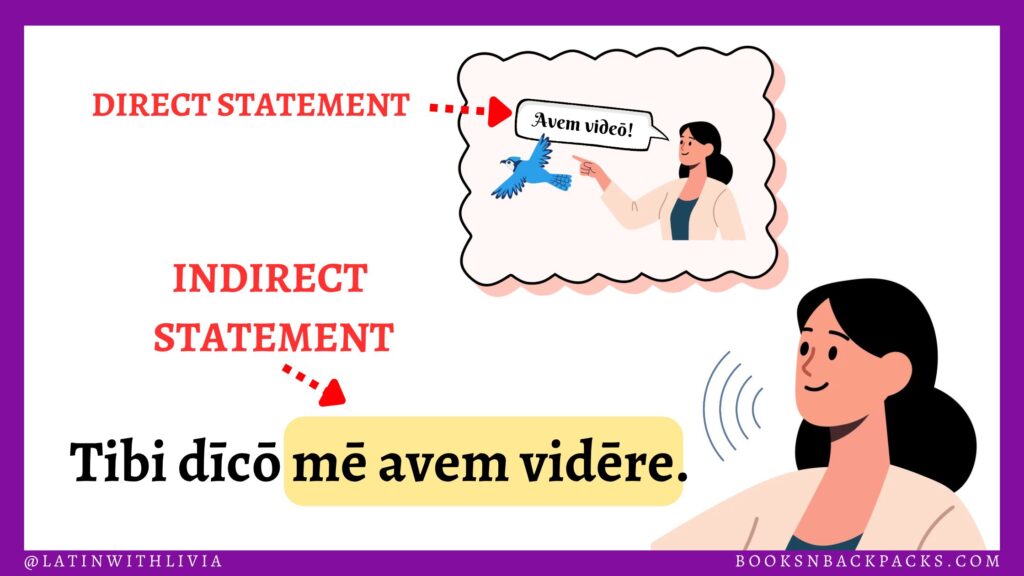
Livia’s original direct statement is “I see a bird!” or, in Latin, avem videō.

Her friend doesn’t hear her, though, so she has to repeat herself. Now she uses an indirect statement to convey the information about the bird: “I am telling you that I see a bird.”
In English, we signal indirect discourse by adding “that”.
In Latin, when we change a direct statement to an indirect statement, we do two things.
- Put the subject of the new indirect statement into the accusative case.
- Convert the verb of the new indirect statement into an infinitive. The tense and voice of the infinitive stay the same as the tense and voice of the original verb.
Here, the subject of avem videō is the implied pronoun ego (I). The accusative form of this personal pronoun is mē.
The verb, videō, is in the present tense, so we need the present active infinitive. This is vidēre.
Then we can put everything back together: Tibi dīcō mē avem vidēre. “I am telling you that I see a bird” or, super literally, “I am telling you myself to see a bird.”
Now let’s consider the friend’s direct statement: “Today Livia saw a bird!” In Latin this would be Līvia avem hodiē vīdit.
To convert this into an indirect statement, we need to put the subject – Līvia – into the accusative case, and then we need to convert the perfect active verb vīdit into a perfect active infinitive.
The resulting sentence is Amīca dīxit Līviam avem hodiē vīdisse, “The friend said that Livia had seen a bird today.” Hyper literally, this would be “The friend said Livia to have seen a bird today.”
This is one way to conceptualize Latin indirect statements: tracing how they develop from direct statements.
But if this confuses you, don’t despair! There is another way to approach the issue, and this is what I will focus on in the remainder of this post.
As you read, remember one fundamental point:
Infinitives in indirect statements indicate relative time.
Present Infinitives in Indirect Statements
Present infinitives indicate that the action of the indirect statement is happening at the same time as the action of the main verb.
Some examples will make this concept much clearer.
Let’s imagine that I am sitting near my window and looking outside. There is a dog playing in my garden.
I make a noise and my husband asks what is happening. I reply that a dog is playing in the garden.
This last sentence is an indirect statement. The direct statement would be, “A dog is playing in the garden!”
EXAMPLE #1
Respondeō canem in hortō lūdere.
I reply that a dog is playing in the garden.
I am replying right now, and the dog is playing right now. The two actions are simultaneous.
The use of the present infinitive lūdere conveys this equivalence in time.
Now let’s imagine that all of this happened yesterday. Yesterday I was sitting at the window and a dog was playing in the garden. My husband asked what was happening.
I replied that a dog was playing in the garden.
EXAMPLE #2
Respondī canem in hortō lūdere.
I replied that a dog was playing in the garden.
I replied in the past (yesterday), and the dog was playing in the garden in the past (yesterday).
In English, we have to change the tense of reply AND the tense of play. I reply becomes I replied and a dog is playing becomes a dog was playing.
In Latin, we only have to change the main verb. Respondeō (present tense) becomes respondī (perfect tense).
The infinitive lūdere remains in the present tense.
Why? Because the action of playing happened at the same time as the action of replying!
This is confusing to us at first, because we aren’t used to this concept of relative time. If you are struggling, I recommend making yourself a timeline.
The main verb is the anchor point. It determines the timing of the entire sentence.
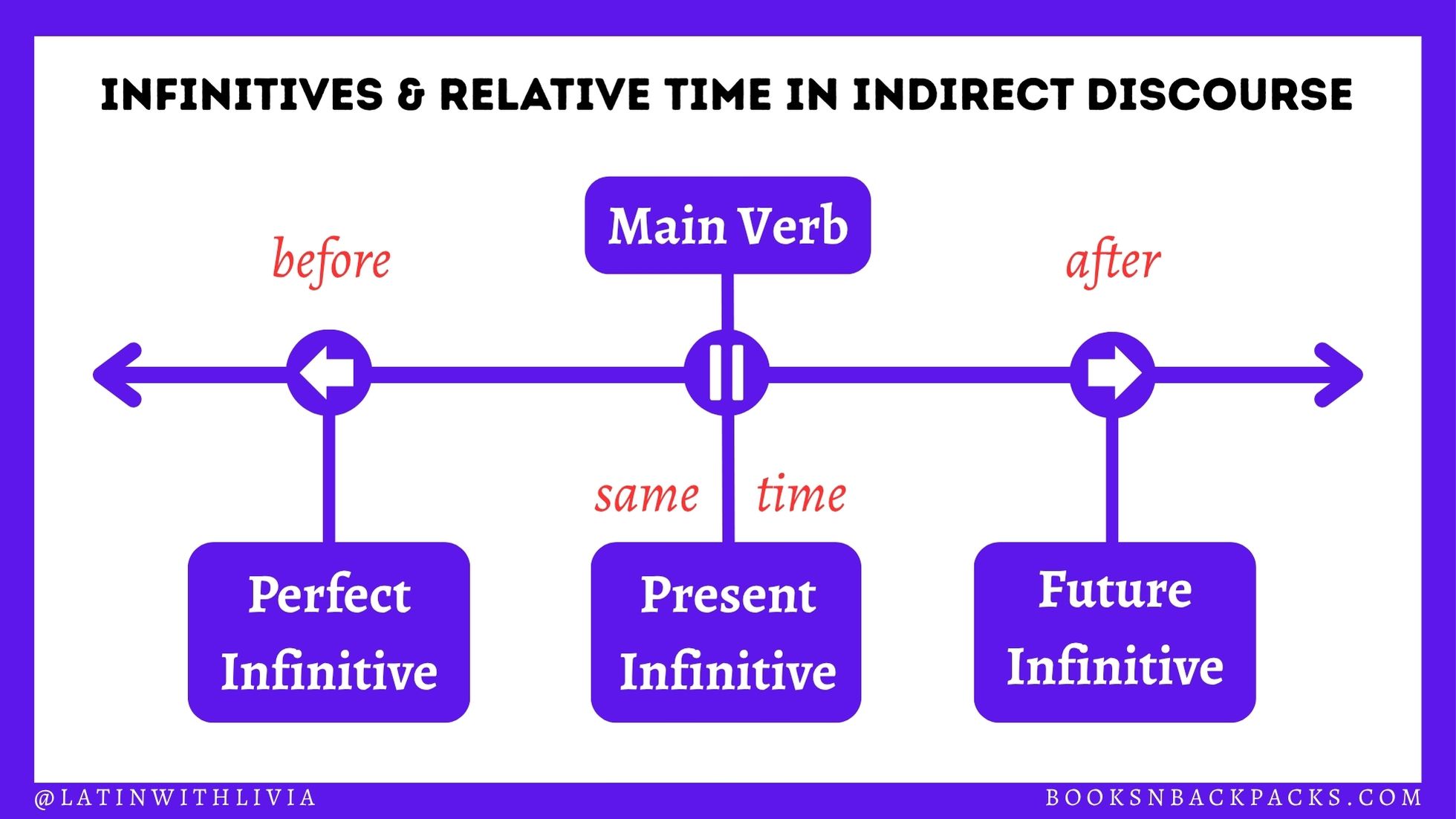
The present infinitive covers action at the same time, so it will be at the same point on the timeline as the main verb. The infinitive takes its timing from the main verb. Infinitives don’t have their own independent timeframe.
Examples
As you read the following example sentences, I want you to think hard about timing. Remember: the action of the present infinitive occurs at the same time as the action of the main verb.
Main verbs are underlined and present infinitives are in red.
EXAMPLE 1
Putābam tē rem pūblicam servāre. = I thought that you were protecting the republic.EXAMPLE 2
Putābō tē rem pūblicam servāre. = I will think that you are protecting the republic.EXAMPLE 3
Putō tē rem pūblicam servāre. = I think that you are protecting the republic.
In Example 1, the main verb (putābam) is in the imperfect tense. This means that our present infinitive servāre also refers to an action that happened IN THE PAST.
In the past, I thought, “You are protecting the republic.”
In Example 2, the main verb (putābō) is in the future tense. This means that our present infinitive servāre also refers to an action that will happen IN THE FUTURE.
In the future, I will think, “You are protecting the republic.”
In Example 3, the main verb (putō) is in the present tense. This means that our present infinitive servāre also refers to an action that is happening IN THE PRESENT.
In the present, I think, “You are protecting the republic.”
Notice that the direct statement never changes: “You are protecting the republic” (rem pūblicam servās). This is why the infinitive never changes its tense.
But the timeline of the thought changes, so servāre refers to a different moment in time in each example.
Is this making sense so far? Let’s look at more examples of the Latin accusative and infinitive in action!
Īrāta dīxerat sē pecūniam nōn habēre. = Angry, she had said that she did not have / was not having the money.
Dux videt urbem in perīculō esse. = The leader sees that the city is in danger.
Stulte, omnēs scient nōs viam dēfendere nōn posse! = Idiot, all will know that we are not able to defend the road!
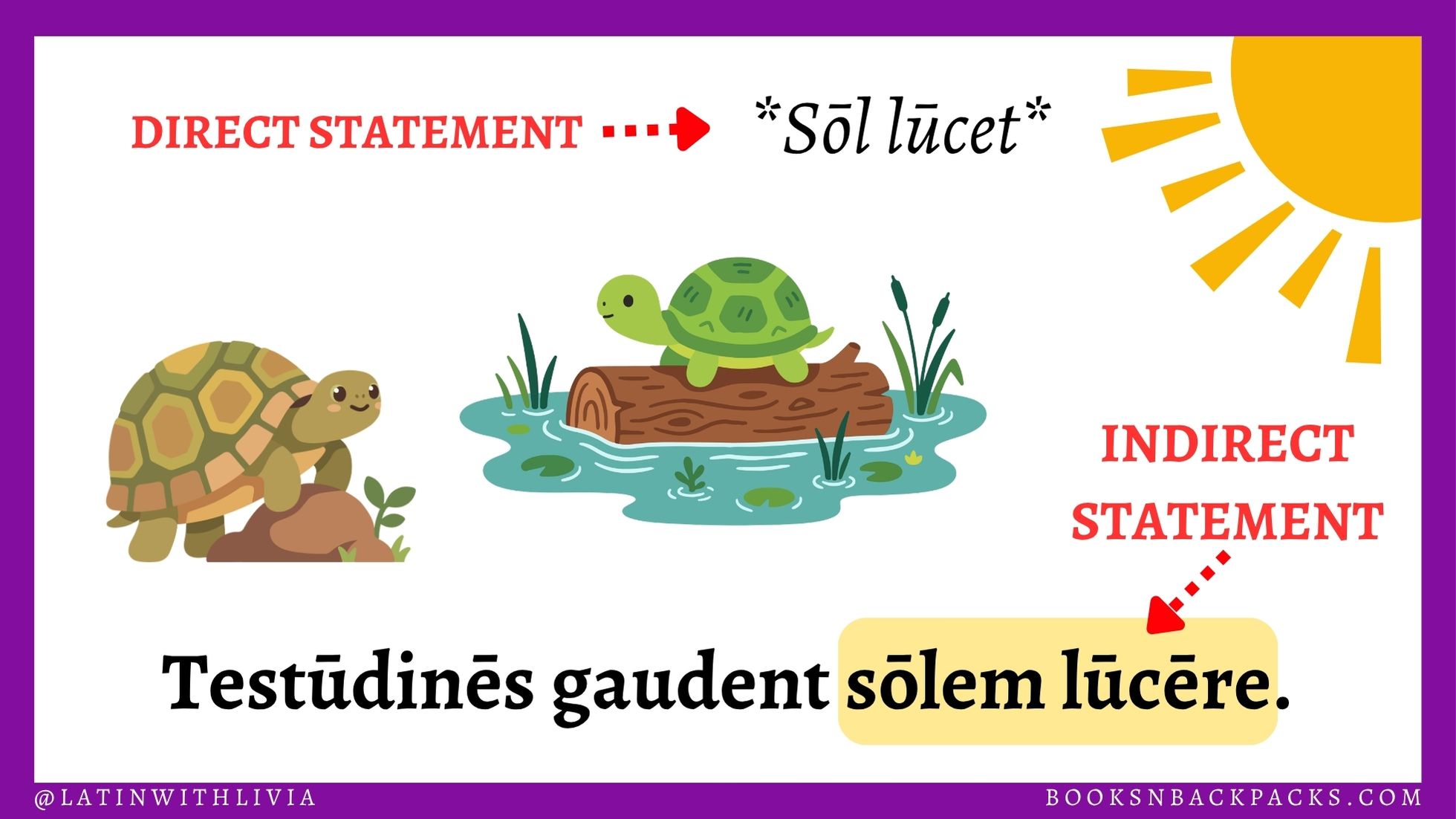
Testūdinēs gaudent sōlem lūcēre. = The turtles are happy that the sun is shining.
Perfect Infinitives in Indirect Statements
Perfect infinitives indicate that the action of the indirect statement happened before the action of the main verb.
Let’s say that I get home from work and I see dirty dishes in the sink. I might say to myself, “My husband ate dinner!” In other words, I see that my husband ate dinner.
EXAMPLE #1
Videō virum cēnāvisse.
I see that my husband ate dinner.
The perfect infinitive cēnāvisse indicates that the action of eating happened BEFORE the action of seeing. This makes sense: my husband ate BEFORE I got home from work.
Now imagine that all of this happened yesterday. I arrived home yesterday and said to myself, “My husband ate dinner!” I saw that my husband had eaten dinner.
EXAMPLE #2
Vīdī virum cēnāvisse.
I saw that my husband had eaten dinner.
Now the main verb vīdī is in the perfect tense. Cēnāvisse is in the perfect tense as well, but remember: the perfect tense of the infinitive indicates relative time.
In this instance, this means that the action of eating happened BEFORE the action of seeing. Again, this makes sense: yesterday my husband ate dinner and THEN I got home from work.
In English, we indicate that the action of the indirect statement happened further in the past by changing the verb to the pluperfect had eaten. In Latin, we can keep the infinitive’s tense the same no matter what happens with the main verb.
Remember: infinitives indicate relative time!
Examples
Main verbs are underlined and perfect infinitives are in red.
EXAMPLE 1
Agricola audit argentum in spēluncā inventum esse. = The farmer hears that silver was found in the cave.EXAMPLE 2
Agricola audīvit argentum in spēluncā inventum esse. = The farmer heard that silver had been found in the cave.EXAMPLE 3
Agricola audīverat argentum in spēluncā inventum esse. = The farmer had heard that silver had been found in the cave.
These example sentences feature a perfect passive infinitive, inventum esse. This is a reminder that passive infinitives can show up in indirect statements, too!
The direct statement would be “Silver was found in the cave” or Argentum in spēluncā inventum est.
In Example 1, the main verb audit is in the present tense. The silver was found BEFORE the present, that is, in the PAST.
In the present, the farmer hears, “Silver was found in the cave.”
In Example 2, the main verb audīvit is in the perfect tense. This means that the silver was found BEFORE the past action of hearing – so, in other words, it was found in the MORE DISTANT past.
In the past, the farmer heard, “Silver was found in the cave.”
Finally, Example 3 has a main verb audīverat in the pluperfect tense. The action of hearing had already happened in the more distant past, so the perfect infinitive signals that the finding of the silver occurred in the EVEN MORE distant past.
In the very distant past, the farmer heard, “Silver was found in the cave.”
The sequence of action is always the same: first, silver is found. Sometime later, the farmer hears about it. This temporal relationship never changes, regardless of the tense of the main verb.
Here are a few more examples.
Arbitrārisne imperātōrem bona cōnsilia cēpisse? = Do you think that the commander made good plans?
Nesciēbāmus uxōrem tuam multa carmina scrīpsisse. = We did not know that your wife had written many poems.
Amīcī negābunt sē coniūrātōs fuisse. = The friends will deny that they were / had been conspirators.
Mihi dīxistī omnia dōna condita esse! = You told me that all the presents had been hidden!
Future Infinitives in Indirect Statements
Future infinitives indicate that the action of the indirect statement will happen AFTER the action of the main verb.
Imagine that I am very busy and I have been meaning to write a letter to a friend. I think to myself, “I will write the letter tomorrow!”
EXAMPLE #1
Putō mē epistulam crās scrīptūram esse.
I think that I will write the letter tomorrow.
I am thinking, today, that I will write the letter tomorrow, in the future.
Now let’s say that I thought to myself yesterday that I would write the letter tomorrow.
EXAMPLE #2
Putāvī mē epistulam crās scrīptūram esse.
I thought that I would write the letter tomorrow.
At this point it should come as no surprise that nothing changes in the Latin indirect statement. The action of the main verb – thinking – is now in the past, but the future infinitive still indicates action AFTER.
Remember the concept of relative time. The most important thing is that the letter-writing will happen AFTER the thinking, regardless of when, exactly, the thinking occurs.
There is one other aspect that I should note here. Future infinitives are formed from a future active participle plus the present infinitive of sum. Since there is a participle involved, the infinitives gender and number can change.
In these examples, mē is the subject of the indirect statement. Since I use feminine pronouns, and I am a singular person, scrīptūram is feminine singular accusative to agree with mē.
But if I were to say, for instance, that I thought my brothers would write the letter tomorrow, I would need to change the participle.
Putāvī frātrēs epistulam crās scrīptūrōs esse.
I thought that my brothers would write the letter tomorrow.
Now the participle, scrīptūrōs, is masculine plural to agree with frātrēs.
Examples
Main verbs are underlined and future infinitives are in red.
EXAMPLE 1
Vīcīnus negat sē fugitūrum esse. = The neighbor denies that he will flee.EXAMPLE 2
Vīcīnus negābat sē fugitūrum esse. = The neighbor was denying that he would flee.EXAMPLE 3
Vīcīnus negābit sē fugitūrum esse. = The neighbor will deny that he will flee.
In Example 1, the main verb negat is in the present tense. First the neighbor’s denial happens, in the present, and the fleeing will or will not happen afterward, in the FUTURE.
In the present, the neighbor says, “I will not flee” (nōn fugiam).
In Example 2, the main verb negābat is in the imperfect tense. This means that the neighbor was repeatedly denying, in the past, that he would flee, in the future of the past.
In the past, the neighbor kept saying, “I will not flee.”
Lastly, Example 3 has a main verb negābit in the future tense. The neighbor will deny, in the future, that he intends to flee in the EVEN MORE DISTANT FUTURE.
In the future, the neighbor will insist, “I will not flee.”
As we have seen with previous examples, the sequence of actions never changes. The denial always occurs before the flight (or the lack thereof).
Here are just a few more examples:
Dux videt urbem in perīculō futūram esse. = The leader sees that the city will be in danger.
Arbitrārisne imperātōrem bona cōnsilia captūrum esse? = Do you think that the commander will make good plans?
Peculiarities: Reflexive Pronouns in Indirect Statements
There are various peculiarities of indirect speech, too many for me to cover in this post. But I do want to address one issue that sometimes confuses my students.
One of the example sentences from the last section involved a reflexive pronoun.
Vīcīnus negat sē fugitūrum esse. = The neighbor denies that he will flee.
Sē is a reflexive pronoun that can variously be translated as “himself”, “herself”, or “themselves”, depending on the context.
An overly literal translation of the above sentence would be “The neighbor denies himself to be about to flee.”
If you think about it, it makes sense that we would need a reflexive pronoun here. The neighbor is making a statement about his own future actions. Sē refers back to vīcīnus, the subject of the main verb. Sē = vīcīnus.
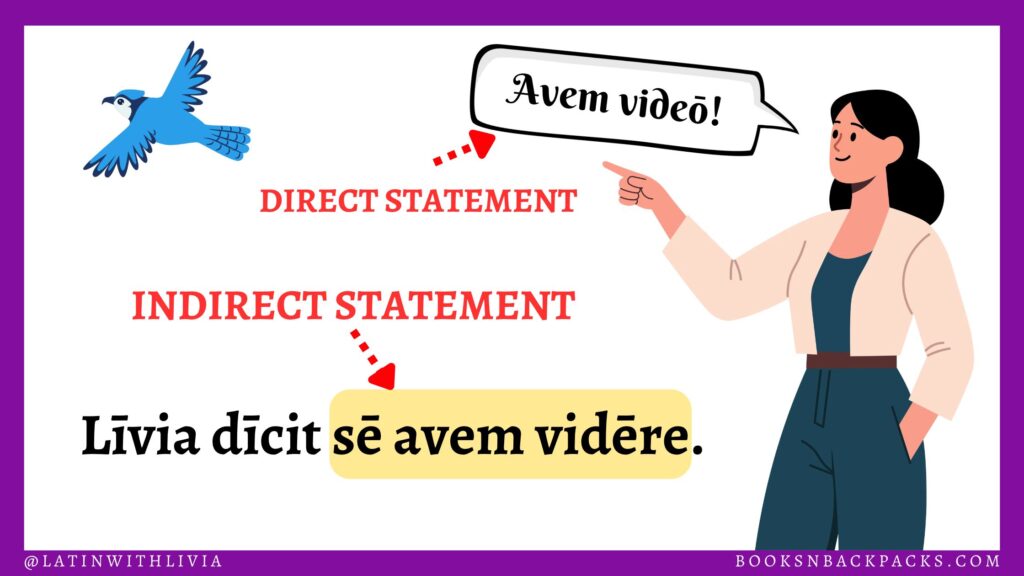
Remember the example, way back at the beginning of this post, of Livia seeing a bird and exclaiming “I see a bird”? Well, if one of Livia’s friends is explaining the situation, she might say, “Livia says that she sees a bird.”
Līvia dīcit sē avem vidēre. = Livia says that she sees a bird.
Sē, the subject of the indirect statement, refers back to Līvia, the subject of the main verb. Sē = Līvia.
A hyper-literal translation would be “Livia says herself to see a bird.”
Conclusion: Watch Out for Tricky Sentences
By now you should have a basic understanding of what Latin indirect statements are and how they work. If all the details aren’t sticking in your mind, that’s okay: it’s all about practice!
The most important thing is to remember that infinitives in indirect statements indicate relative time. If you bear that in mind, all the other details can come later.
One of the things that makes Latin indirect statements hard is that Romans often incorporate them in contexts that seem strange to us. For instance, look at this quote from Valerius Flaccus’ Argonautica that I came across recently:
. . . et iam circumspicit Aeson
praeveniat quō fīne minās, quae fāta capessat
digna satis; magnōs obitūs nātumque domumque
et genus Aeolium pugnātaque poscere bella.And now Aeson looks around [to see]
Valerius Flaccus, Argonautica 1.767-770
in what way he can anticipate the threats, what death he can seek
sufficiently worthy; [he realizes] that (his) son and house
and Aeolian lineage and wars fought demand a great end.
If you look at my translation, you will see that I added some words in brackets. “He realizes” is not there in the Latin. Instead, the indirect statement is triggered by circumspicit (“he looks around”), which implies that Aeson is looking around and thinking about a solution.
Another difficulty is that here the direct object of the indirect statement, magnōs obitūs (“great end”), comes first. Usually the first accusative in an indirect statement will be the subject, but sometimes poets depart from standard word order for artistic effect.
All this is to say that indirect statements can be tough. But this post gives you the foundation to keep exploring!
YOU MAY ALSO LOVE:

