
Latin Superlative Adjectives: The Most Essential Guide
Welcome to the most essential guide to Latin superlative adjectives! After all, I could not write a post about superlatives without including a superlative in the title.
Superlatives express that a person or thing possesses the highest degree of a quality or characteristic. If my students should say that I am the wisest Latin teacher ever, then they need to use a superlative.
They would also use a superlative to indicate that my class is the hardest, the most exciting, the most bizarre, and so forth.
Superlatives in Latin generally end in –issimus, a, um, but as we shall see, there are many exceptions. Without further ado, let’s dive into the most helpful and most thorough discussion of Latin superlatives!

This post may contain affiliate links and I may receive a commission, at no extra cost to you, if you make a purchase through a link. See my disclosures for more details.
What is a superlative adjective?
In Latin, just like in English, adjectives have three degrees. These are forms that establish the degree or intensity of a given quality.
The Cambridge English dictionary defines superlative as “of the highest quality; the best”. So it should come as no surprise that a superlative – in linguistics – refers to an adjective that expresses the highest possible intensity of a characteristic.
Let’s take a look at the three degrees of an adjective in English and in Latin.
| Positive | Comparative | Superlative |
|---|---|---|
| fortis, e | fortior, fortius | fortissimus, a, um |
| brave, strong | braver, stronger | bravest, strongest |
The positive degree is the default degree. This is the form of an adjective that will appear in Latin dictionaries or in the glossary at the back of your textbook.
✨ Psst! Are you looking for a good Latin dictionary? This compact and affordable gem is my top recommendation for beginning students! ✨
The comparative degree comes next. I have written an entire post on the Latin comparative, so here I will just note that comparatives express that X is “more _________” than Y .
But what if you are dealing with more than two people or things? What if you have X, Y, and Z, and you want to say that Z is the “most _______” of all?
This is when the superlative degree comes in! Superlatives state that a noun has the highest possible degree of a certain quality. Bravest, happiest, best, most eager . . .
In English, we form superlatives by adding –est to the end of a positive adjective or by adding most in front of the adjective. In Latin, there are various types of superlatives, but the most common features the ending –issimus, a, um.
In the next few sections we will discuss how to create and decline Latin superlatives. If it all seems kind of abstract, don’t worry!
I have included exercises for you to test your knowledge, PLUS there is an entire section below dedicated to superlatives in action. The example sentences, including quotes from Roman authors like Cicero, will help you to get a good grasp of this new grammatical concept.
How to form Latin superlative adjectives
Every Latin superlative adjective has three forms in the nominative singular.
EXAMPLE: fortissimus, fortissima, fortissimum – usually abbreviated to fortissimus, a, um
The first form, fortissimus, is the masculine singular nominative. The second, fortissima, is the feminine singular nominative, and the third, fortissimum, is the neuter singular nominative.
All Latin superlatives belong to the 1st and 2nd declension (in other words, they are 2-1-2 adjectives). It does not matter what declension the adjective is in its positive degree.
For example, fortis, e is a 3rd-declension adjective in the positive degree, but its superlative fortissimus, a, um is a 2-1-2 adjective.
If you aren’t sure what any of these categorizations mean, then I recommend that you head over to my beginner’s guide to Latin adjectives. This will give you a firm basis of knowledge, and then you can come back to dive further into superlatives.
If you are feeling comfortable with all the terminology, let’s get into the nitty-gritty details of how to build Latin superlatives.
Regular Latin Superlatives
To form a regular superlative adjective in Latin, there are two (relatively) simple steps.
- Find the base of the positive adjective.
- Add -issimus, a, um.
I say that these are relatively simple steps because finding a Latin adjective’s base (sometimes called a stem) can get complicated. In fact, I have an entire post dedicated to finding adjective bases!
Luckily, there are only three methods that matter for us.
#1: If you are looking at a 2-1-2 adjective ending in –us, a, um, simply remove –us from the masculine nominative singular to find the base. Here are some examples!
| Positive Degree | Positive Base | Superlative |
|---|---|---|
| novus, a, um ‘new’ | nov- | novissimus, a, um ‘newest, last’ |
| saevus, a, um ‘fierce’ | saev- | saevissimus, a, um ‘fiercest’ |
| laetus, a, um ‘joyful’ | laet- | laetissimus, a, um ‘happiest’ |
| certus, a, um ‘sure’ | cert- | certissimus, a, um ‘most sure’ |
| altus, a, um ‘tall’ | alt- | altissimus, a, um ‘tallest’ |
#2: For adjectives that end in –is, e in the positive degree, remove –is from the masculine nominative singular to find the base. (These are what we call “two-termination” 3rd-declension adjectives.)
#3: For adjectives that have only one form in the nominative singular, remove –is from the genitive singular of the positive degree. (These are what we call “one-termination” 3rd-declension adjectives, and the genitive singular will always be provided along with the nominative singular.)
| Positive Degree | Positive Base | Superlative |
|---|---|---|
| gravis, e ‘serious, heavy’ | grav- | gravissimus, a, um ‘heaviest’ |
| trīstis, e ‘sad’ | trīst- | trīstissimus, a, um ‘saddest’ |
| fēlīx (gen. fēlīcis) ‘lucky’ | fēlīc- | fēlīcissimus, a, um ‘luckiest’ |
| dīves (gen. dīvitis) ‘wealthy’ | dīvit- | dīvitissimus, a, um ‘wealthiest’ |
To reiterate, the first two adjectives – gravis, e and trīstis, e – are what we call “two-termination” 3rd-declension adjectives. You can simply remove –is to find the base.
Fēlīx and dīves are examples of one-termination 3rd-declension adjectives. You remove –is from the genitive singular to find the base.
Now it’s your turn to practice! Can you create the superlatives of the adjectives in Exercise 1? Once you have your responses ready, toggle to “Answers” to check your work.
- superbus, a, um ‘proud’
- potēns, gen. potentis ‘powerful’
- plēnus, a, um ‘full’
- turpis, e ‘shameful, ugly’
- dulcis, e ‘sweet’
- stultus, a, um ‘stupid’
- audāx, gen. audācis ‘bold’
- dūrus, a, um ‘hard, tough’
- positive base: superb-; superlative: superbissimus, a, um; translation: ‘proudest’
- positive base: potent-; superlative: potentissimus, a, um; translation: ‘most powerful’
- positive base: plēn-; superlative: plēnissimus, a, um; translation: ‘fullest’
- positive base: turp-; superlative: turpissimus, a, um; translation: ‘most shameful, ugliest’
- positive base: dulc-; superlative: dulcissimus, a, um; translation: ‘sweetest’
- positive base: stult-; superlative: stultissimus, a, um; translation: ‘most stupid’
- positive base: audāc-; superlative: audācissimus, a, um; translation: ‘boldest’
- positive base: dūr-; superlative: dūrissimus, a, um; translation: ‘hardest, toughest’
Superlatives ending in –rimus
If a Latin adjective’s nominative singular masculine ends in –er, then simply add –rimus, a, um to form the superlative.
It does not matter what declension the positive adjective belongs to. In the following chart, you can see 2-1-2 adjectives such as miser, misera, miserum and 3rd-declension adjectives such as ācer, ācris, ācre.
| Positive Adjective | Superlative Adjective |
|---|---|
| miser, misera, miserum ‘wretched’ | miserrimus, a, um ‘most wretched’ |
| līber, lībera, līberum ‘free’ | līberrimus, a, um ‘most free’ |
| sacer, sacra, sacrum ‘sacred’ | sacerrimus, a, um ‘most sacred’ |
| ācer, ācris, ācre ‘sharp’ | ācerrimus, a, um ‘sharpest’ |
| celer, celeris, celere ‘swift’ | celerrimus, a, um ‘swiftest’ |
See how –rimus, a, um is slapped on the end of the masculine nominative singular? Miser + rimus gives us miserrimus, while celer + rima gives us celerrima, and so forth.
Time for some more practice. Can you form the superlative of each of the following Latin adjectives? This exercise has mixed “regular” and -rimus superlatives, so be careful!
- aeger, aegra, aegrum ‘sick’
- ferōx, gen. ferōcis ‘fierce’
- amīcus, a, um ‘friendly’
- pauper, gen. pauperis ‘poor’
- sapiēns, gen. sapientis ‘wise’
- tener, tenera, tenerum ‘tender’
- longus, a, um ‘long’
- mollis, e ‘soft’
- masculine nominative singular ends in –er; superlative: aegerrimus, a, um; translation: ‘sickest’
- positive base: ferōc-; superlative: ferōcissimus, a, um; translation: ‘fiercest’
- positive base: amīc-; superlative: amīcissimus, a, um; translation: ‘friendliest’
- masculine nominative singular ends in –er; superlative: pauperrimus, a, um ‘poorest’
- positive base: sapient-; superlative: sapientissimus, a, um; translation: ‘wisest’
- masculine nominative singular ends in –er; superlative: tenerrimus, a, um; translation: ‘most tender’
- positive base: long-; superlative: longissimus, a, um; translation: ‘longest’
- positive base: moll-; superlative: mollissimus, a, um; translation: ‘softest’
BONUS: There is another common adjective that has a superlative ending in –rimus. This is vetus, veteris “old”, a one-termination 3rd-declension adjective. The positive base is veter-, which ends in –er, so we simply add –rimus, a, um to get veterrimus, a, um “oldest”.
Superlatives ending in –limus
There are six Latin adjectives that have superlative forms ending in –limus, a, um. Here they are:
| Positive Adjective | Superlative Adjective |
|---|---|
| facilis, e ‘easy’ | facillimus, a, um ‘easiest’ |
| difficilis, e ‘difficult’ | difficillimus, a, um ‘most difficult’ |
| similis, e ‘similar’ | simillimus, a, um ‘most similar’ |
| dissimilis, e ‘different’ | dissimillimus, a, um ‘most different’ |
| humilis, e ‘low, poor’ | humillimus, a, um ‘lowest, poorest’ |
| gracilis, e ‘thin, slight’ | gracillimus, a, um ‘thinnest, slightest’ |
Notice that all six of these adjectives belong to the 3rd declension, and all six end in –ilis, e.
It is important to stress, however, that NOT ALL adjectives in –ilis, e have irregular superlatives. It is ONLY these six adjectives.
Other adjectives ending in –ilis, e form their superlatives regularly. For example, ūtilis, e ‘useful’ gives us the superlative ūtilissimus, a, um ‘most useful’. Nōbilis, e ‘famous, renowned’ has the superlative nōbilissimus, a, um ‘most famous, most renowned’.
Focus on remembering that two sets of opposites – facilis / difficilis and similis / dissimilis – have irregular superlatives in Latin. One way to think about it is that it is natural that HARD (difficilis) and DIFFERENT (dissimilis) would have hard, different superlatives.
Humilis, e and especially gracilis, e are not as commonly used. In fact, I can only find one instance of gracillimus, a, um in classical Latin! The historian/biographer Suetonius notes that the emperor Nero had gracillimīs crūribus “the thinnest legs” (Life of Nero 51).
Superlatives with maximē
A small group of Latin adjectives has comparatives formed with the adverb maximē “most”. Instead of adding –issimus, a, um to the adjective’s base, we add maximē in front of the positive degree of the adjective.
A superlative with maximē generally appears when an adjective’s positive degree ends in -eus or -ius.
| Positive | Superlative |
|---|---|
| idōneus, a, um = suitable | maximē idōneus, a, um = most suitable |
| contrārius, a, um = hostile | maximē contrārius, a, um = most hostile |
| necessārius, a, um = necessary | maximē necessārius, a, um = most necessary |
This happens because the bases of these adjectives end in a vowel. It would be kind of awkward to add –issimus to idōne-, the base of idōneus. *idōneissimus sounds weird and would be hard to pronounce.
But beware: the rules around the use of maximē are not set in stone. Some adjectives don’t seem to form superlatives in Latin at all when we might expect to see forms with maximē, while other adjectives can take maximē where we might not expect it.
The most important thing is to be able to recognize maximē + adjective as a superlative form if you see it.
Completely Irregular Latin Superlatives
So far we have talked about regular Latin superlatives and about superlatives that are, shall we say, predictably irregular. It is now time to turn to the truly irregular superlatives: the equivalents of English good > best and bad > worst.
The following chart shows the positive, comparative, and superlative degrees of six common adjectives. I have included the comparative for your reference, since irregular comparatives and superlatives often resemble each other (and this can help with recall).
| Positive | Comparative | Superlative |
|---|---|---|
| bonus, a, um = good | melior, melius = better | optimus, a, um = best |
| malus, a, um = bad | peior, peius = worse | pessimus, a, um = worst |
| parvus, a, um = small | minor, minus = smaller | minimus, a, um = smallest |
| magnus, a, um = big | maior, maius = bigger | maximus, a, um = biggest |
| multus, a, um = much, many | (—), plūs = more | plūrimus, a, um = most |
| superus, a, um = above | superior, superius = higher | suprēmus, a, um = highest, last summus, a, um = highest, best |
Despite their irregularity, all of these superlatives are 2-1-2 adjectives (as the –us, a, um ending indicates). Another nice thing is that these superlatives give us many English derivatives.
If you are an optimist, you believe that the best will happen; if you are a pessimist, on the other hand, you are always expecting the worst. Other derivatives include minimal, maximum, supreme, and summit.
How to decline Latin superlative adjectives
Good news: all Latin superlatives are declined in the same way! It does not matter if they are regular or irregular; they all have 1st- and 2nd-declension endings.
In other words, they are all 2-1-2 adjectives.
👉 Need a refresher on 2-1-2 adjectives? Read my beginner’s guide to Latin adjectives!
To decline superlatives, follow these simple steps:
- Identify the base/stem of the superlative.
- Add 1st and 2nd-declension endings.
The base of the superlative can be found by removing –us from the masculine nominative singular. It is important to note that the superlative base is different from the positive base.
| Positive | Positive Base | Superlative | Superlative Base |
|---|---|---|---|
| novus, a, um | nov- | novissimus, a, um | novissim- |
| miser, misera, miserum | miser- | miserrimus, a, um | miserrim- |
| trīstis, e | trīst- | trīstissimus, a, um | trīstissim- |
| fēlīx (gen. fēlīcis) | fēlīc- | fēlīcissimus, a, um | fēlīcissim- |
| facilis, e | facil- | facillimus, a, um | facillim- |
Once you have identified the superlative’s base, you are ready to add the proper declension endings.
The following chart shows fēlīcissimus, a, um fully declined. An interpunct (·) indicates the break between the base and the declension ending.
(Note: this chart looks much better in desktop than on mobile!)
| Case & No. | Masc. | Fem. | Neut. |
|---|---|---|---|
| Nom Sing | fēlīcissim·us | fēlīcissim·a | fēlīcissim·um |
| Gen Sing | fēlīcissim·ī | fēlīcissim·ae | fēlīcissim·ī |
| Dat Sing | fēlīcissim·ō | fēlīcissim·ae | fēlīcissim·ō |
| Acc Sing | fēlīcissim·um | fēlīcissim·am | fēlīcissim·um |
| Abl Sing | fēlīcissim·ō | fēlīcissim·ā | fēlīcissim·ō |
| Nom Pl | fēlīcissim·ī | fēlīcissim·ae | fēlīcissim·a |
| Gen Pl | fēlīcissim·ōrum | fēlīcissim·ārum | fēlīcissim·ōrum |
| Dat Pl | fēlīcissim·īs | fēlīcissim·īs | fēlīcissim·īs |
| Acc Pl | fēlīcissim·ōs | fēlīcissim·ās | fēlīcissim·a |
| Abl Pl | fēlīcissim·īs | fēlīcissim·īs | fēlīcissim·īs |
And there you go . . . you now can decline any superlative adjective.
Notice that –issim- shows up in all of the case forms. This is the most recognizable sign of a superlative. When you see -issim-, you know that the text is dealing with extremes.
Of course, some superlatives will feature –illim– or -errim- instead, so stay alert. But –issim- is a foolproof indication of a superlative.
This brings us to the last – and arguably most important – section of this post. It is time to look at Latin superlative adjectives in action!
Examples of Latin Superlatives in Action
The standard way to translate a superlative in English is “__________est” or “most _________”. Depending on the context, however, other translations may be more appropriate.
In the following sections, I will cover some of the most common surroundings in which you might find a Latin superlative.
The Most X of All Xs
The superlative frequently appears alongside the genitive case. This is how Romans expressed the idea that someone or something is “the _______est / most ________ of all“.
Say that you love horses and you want to say that horses are the best of all animals. You need to put “of all animals” into the genitive case.
Equus est optimus omnium animālium. = The horse is the best of all animals.
This is what we call the partitive genitive or the genitive of the whole. Horses are “part” of the category of animals, so animals are the “whole”. Hence the name.

Now let’s study two examples taken from ancient Roman texts. Superlatives are in red, while partitive genitives are in blue.
CALLIDIMATES: Eu, Philolachēs, salvē, amīcissime mī omnium hominum! = Excellent, Philolaches, hello, dearest to me of all men!
Plautus Mostellaria 339-340
In this line from Plautus’ play Mostellaria, Callidimates greets Philolaches by calling him the “dearest” or “friendliest” of all men. Omnium hominum is the genitive of the whole, since Philolaches is dearest of the “whole” category of men.
(Incidentally, amīcissime is in the vocative case since it modifies Philolachēs, a noun of direct address.)
Suēbōrum gēns est longē maxima et bellicōsissima Germānōrum omnium. = The tribe of the Suevi is by far the greatest and most warlike of all the Germans.
Caesar, De Bello Gallico 4.3
In this passage, Julius Caesar is describing the character and customs of various Germanic tribes. We have two superlatives – maxima (irregular) and bellicōsissima (regular) – both describing the gēns Suēbōrum. The partitive genitive is Germānōrum omnium since the Suevi are “part” of the Germans as a whole.
By the way, I should clarify that we do not have to have the adjective omnium in these expressions. Caesar could have also written maxima et bellicōsissima Germānōrum (“greatest and most warlike of the Germans”) and that would also make sense. It is just that omnium (“of all”) intensifies the statement.
As we shall see in the next section, the superlative can be “weakened” to merely indicate eminence. So adding a genitive can stress that no, really, we are dealing with the best of all.
Very X / Extremely X
Sometimes a Latin superlative indicates a high degree or intensity without an explicit comparison being made.
Haec rosa est pulcherrima. = This rose is very / extremely / exceedingly beautiful.
In this sentence, there is no mention of other roses or other flowers to form a comparison. The focus is on the specific rose in question, and any comparison is implicit.
It’s kind of like if someone thanks you and you respond with “You are most welcome”. “Most welcome” is technically a superlative, but you aren’t using it to compare your interlocutor to other people who are somehow less welcome.
Rather, what you mean is that this person is very welcome and that you are happy to have helped them out.
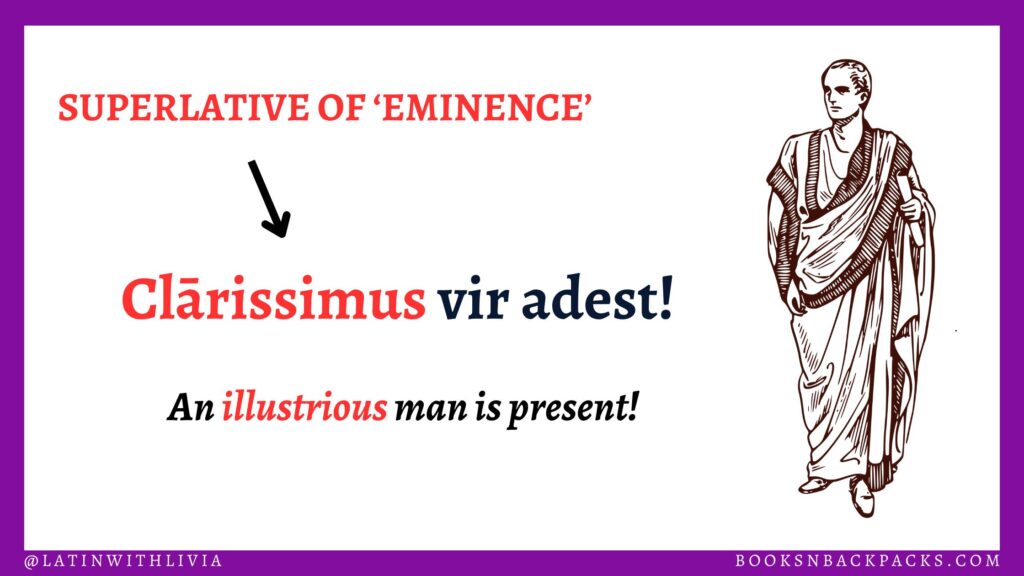
My favorite grammar book calls this the superlative of eminence and states, “The Superlative of Eminence is much used in complimentary references to persons and may often be translated by the simple positive” (§291b).
Cicero, a major fan of superlatives, gives us an excellent example. He is arguing in favor of the Lex Manilia of 66 B.C.E., a law which ultimately granted Pompey sole authority in the east during the Third Mithridatic War.
Quid tam inūsitātum quam ut, cum duo cōnsulēs clārissimī fortissimīque essent, eques Rōmānus ad bellum maximum formīdolōsissimumque prō cōnsule mitterētur? Missus est.
What is so unprecedented as that – although there were two very illustrious and brave consuls – a Roman knight was sent in place of a consul to an exceedingly great and terrifying war? (And yet) he was sent.
Cicero, Pro Lege Manilia 62.1
Cicero is emphasizing that Pompey, the eques Rōmānus, has already been sent on extraordinary missions. There were two consuls who could have been sent to a previous war instead, but Pompey was chosen anyway.
By clārissimī fortissimīque, Cicero doesn’t mean that the two consuls were the absolute “most illustrious and bravest” consuls ever. Instead he is trying to establish a high degree of illustriousness and bravery: the consuls (presumably) had sufficient competence to fight a war, and yet Pompey was chosen regardless.
The same is true of maximum formīdolōsissumque. This war is NOT the most terrifying of all wars that the Romans had ever faced (surely that honor would belong to the Second Punic War). Cicero uses the superlatives to emphasize the dire circumstance, but there is no actual comparison at stake here.
Superlatives used in this way can have various stylistic nuances. The tone can range from sincere emphasis to conventional respect to sarcasm. After all, you can shower someone with flattering superlatives and not mean a single one!
The most important takeaway for you is that Latin superlatives can be translated in different ways. Clārissimus could mean “most illustrious”, but also “very illustrious”, “exceedingly illustrious”, or simply “illustrious”. It all depends on the context.
As X As Possible
If Romans wanted to intensify a superlative, there were several options. We have already seen how you can add a partitive genitive. Now let’s look at what happens if you add quam or vel in front of a Latin superlative.
Both quam and vel are tricky little words that can mean many things. When combined with a superlative, they convey the idea of “the most ______ possible” or “the very _______est possible”.
Coquus cēnam quam optimam parāvit. = The cook prepared the best possible / the very best dinner.
Quam intensifies optimam, changing the meaning from “best” or “very good” to “best possible”.

Note that both quam and vel are added directly in front of the superlative in question. For an example with vel, we shall turn to one of Cicero’s letters.
Cicero is responding to his friend Gaius Furnius and commenting on the tumultuous political situation of the late Republic.
Lēctīs tuīs litterīs [. . .] quod dē Plancī et Brutī concordiā scrībis, in eō vel maximam spem pōnō victōriae.
After reading your letter [. . .] I place the greatest possible hope of victory in that which you write about the alliance between Plancus and Brutus.
Cicero, Epistulae ad Familiares 10.26.1
Vel intensifies maximam, thus emphasizing that Cicero sees this alliance as their best and highest chance of success.
For good measure, let’s look at another quote from Cicero, this one taken from one of his Philippics (speeches written in 44-43 B.C.E. against Marc Antony). Here he is urging the Roman senate not to make peace with Antony.
extorquērī manibus arma non possunt; receptuī signum aut revocātiōnem ā bellō audīre nōn possumus; spērāmus optima, patī vel difficillima mālumus quam servīre.
Our weapons cannot be torn from our hands; we cannot hear a signal for retreat or a withdrawal from war; we hope for the best, we prefer to suffer the most difficult circumstances possible rather than be slaves.
Cicero, Philippics 13.15
Difficillima stands on its own as a substantive. Since it is neuter plural, we can supply “things” or “circumstances” in our translation to produce more natural-sounding English.

Superlatives of Order and Succession
Some superlatives indicate location in space or time, and these have an idiomatic usage. An excellent example is summus, a, um, which means “highest”. Consider the following sentence:
Domus rēgīnae sita est in summā arce. = The queen’s house is located on the highest part of the citadel.
A literal translation into English would be “in the highest citadel”, but this is inaccurate. Summa arx does not mean the highest of a series of citadels; instead it refers to the highest part of one specific citadel.
Here is a list of adjectives that can be used in this way. The first definition is the literal one, and the second is the more accurate one.
- extrēmus, a, um = ‘outermost, farthest, last’ ~ ‘the end, outermost part of’
- īmus, a, um = ‘lowest, deepest’ ~ ‘the bottom, depths, lowest part of’
- medius, a, um = ‘middle’ ~ ‘the middle, midst of’
- novissimus, a, um = ‘latest, last’ ~ ‘the end, rear of’
- summus, a, um = ‘highest’ ~ ‘the top, highest part of’
While this is not an exhaustive list, it will give you a good feel for this construction. NOTE: Medius, a, um is not a superlative, but I have included it because it is so common.
Read the following examples carefully and try to understand the general pattern.
- in extrēmō tertiō librō = at the end of the third book
- extrēmīs digitīs = with the ends/tips of the fingers
- ad īma ossa = to the depths of (his/her) bones
- in īmā rūpe = in the deepest part of the cave
- in mediō marī = in the middle of the sea
- ex mediā morte = from the midst of death
- novissimum agmen = the rear of the battleline
- novissima cauda = the tip/end of the tail
- summī montēs = the tops of the mountains / the mountain peaks
- in summā viā = in the highest part of the road
Here is one final illustration so you can visualize the meaning!

Final Thoughts on Latin Superlatives
Do you feel more comfortable with superlatives now? I hope so!
If you have not completed the exercises above, I highly recommend that you go back and do so. It is good to practice forming superlatives so that you can recognize them more easily when you are reading a Latin text.
This post has focused on superlative adjectives, but superlative adverbs also exist. We form superlative adverbs by adding –ē to the superlative adjective’s base.
| Superlative Adj. | Superlative Adj. Base | Superlative Adverb |
|---|---|---|
| fortissimus, a, um ‘bravest’ | fortissim- | fortissimē ‘most bravely’ |
| celerrimus, a, um ‘quickest’ | celerrim- | celerrimē ‘most quickly’ |
| maximus, a, um ‘greatest’ | maxim- | maximē ‘most greatly’ |
These superlative adverbs can be intensified by quam and vel, just like superlative adjectives.
Quam celerrimē redeāmus! = Let’s return as quickly as possible!
👉 Want to learn more? I’ve got you covered. Head over to my guide to Latin adverbs!
There is so much information packed into this post, so don’t worry if not everything has sunk into your brain. You can always bookmark this page and come back to it in the future!
YOU MAY ALSO LOVE:
My Favorite Latin-Learning Resources (Free & Paid)
7 Best Apps for Learning Latin

